

Your cart is currently empty!
Why Overthinking Is Common in Dating
Almost everyone who has dated seriously knows the experience of overthinking — rereading a text for hidden meaning, mentally replaying a date to find the moment things shifted, drafting and deleting a message five times before sending something simple. It’s such a common experience that it’s practically a dating cliché, and yet it rarely feels less overwhelming just because it’s common.
Understanding why overthinking happens so consistently in dating — more than in most other areas of life — makes it easier to work with the tendency rather than treating it as a personal failing.
Dating Runs on Ambiguous Information
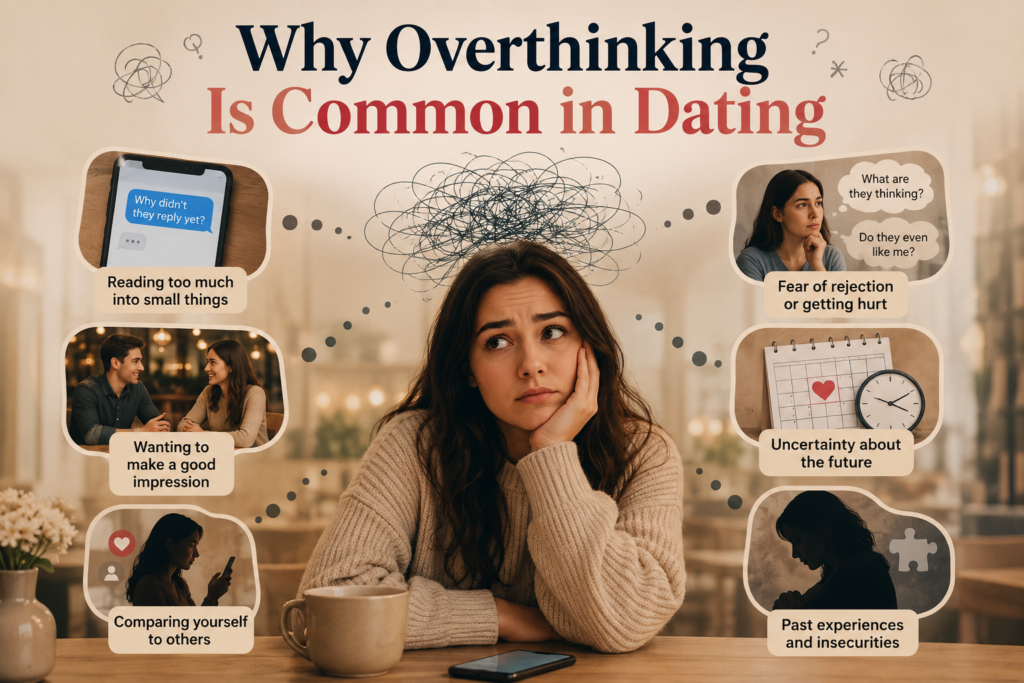
Most overthinking is a response to a specific condition: incomplete or ambiguous information about something that matters to you. Dating is structurally full of this kind of ambiguity. A text without tone of voice, a pause in a conversation, a slower-than-expected reply — all of these are genuinely open to multiple interpretations, and your brain doesn’t like leaving genuine ambiguity unresolved.
This is different from overthinking a decision where more information is actually available if you look for it. In dating, especially early on, there often isn’t more information readily accessible — you can’t ask someone why they took four hours to reply without it feeling disproportionate to the situation, so the mind fills the gap with analysis instead.
The Brain Treats Uncertainty as a Problem to Solve
Human brains are pattern-recognition machines, wired to find explanations for uncertain situations, especially emotionally significant ones. When you don’t have enough information to form a clear conclusion, your brain doesn’t simply shrug and move on — it keeps searching, generating hypotheses, testing them against available evidence, discarding some, favoring others.
This process is useful in many contexts — it’s how humans solve genuinely solvable problems. The trouble is that a lot of early dating uncertainty isn’t actually solvable through more analysis. No amount of rereading a text will definitively reveal someone’s internal emotional state. But the brain doesn’t always know the difference between a solvable problem and an unsolvable one, so it keeps applying the same strategy regardless.
Overthinking Increases With Investment
The amount of overthinking someone experiences tends to scale directly with how much they care about the outcome. This is why people often report barely thinking about a date they weren’t very interested in, while spiraling over a text from someone they really like. The stakes, real or perceived, drive the intensity of the analysis.
This isn’t a flaw — it’s actually a sign that something matters to you. The discomfort comes not from caring, but from caring about something you don’t yet have enough information to feel settled about. That combination — high investment, low certainty — is almost a textbook recipe for overthinking, regardless of how emotionally grounded someone is in other areas of life.
Past Experience Shapes How Much You Overthink
People with a history of inconsistent or unpredictable relationships often overthink more in new dating situations, even ones that are objectively going well. This happens because the nervous system has learned, from real past experience, that ambiguous signals can precede painful outcomes. That learned vigilance doesn’t switch off just because a new situation is actually safer — it gets applied by default, sometimes producing overthinking that’s disproportionate to the actual risk present in the current relationship.
This is worth naming because it reframes overthinking not as an irrational personality trait, but as a learned protective response that made sense given past experience, even when it’s not perfectly calibrated to a new, different situation.
Overthinking Is Partly a Result of Limited Access to the Other Person’s Perspective
In most other important decisions, you have some ability to gather direct information — asking colleagues for feedback, researching a purchase, consulting an expert. In dating, especially early on, the person whose internal state you’re trying to understand is often the one source of information you feel you can’t directly and comfortably access without it feeling like too much, too soon.
This limitation forces people into indirect analysis — inferring meaning from response times, word choice, and behavioral patterns — rather than simply asking. That indirect approach is inherently less reliable and more effortful than direct information-gathering, which is part of why it produces so much rumination.
Social and Cultural Amplifiers
Modern dating culture has, in some ways, actively encouraged overthinking by turning texting analysis into a shared social activity. Group chats dedicated to analyzing a single text message, online content built entirely around “decoding” dating behavior, and a broader cultural obsession with identifying red flags have all normalized — and arguably intensified — the habit of extracting maximum meaning from minimal information.
This isn’t necessarily harmful in small doses (getting outside perspective can genuinely help), but it can also reinforce the belief that enough analysis will eventually produce certainty, when in reality, some uncertainty in early dating simply isn’t resolvable through more thinking, no matter how many people weigh in.
Overthinking Versus Useful Reflection
It’s worth distinguishing overthinking from genuinely useful reflection. Useful reflection asks: what do I actually know, and what would help me learn more? It tends to lead somewhere — a decision, a question you plan to ask, a boundary you want to set. Overthinking tends to loop without resolution — rehashing the same scenario repeatedly without generating any new action or clarity, simply repeating the same uncertain thoughts on repeat.
A practical check: if you’ve been thinking about the same situation for more than a few minutes without landing on any new insight or next step, you’ve likely crossed from reflection into overthinking, and continuing to analyze probably won’t produce anything more useful than what you’ve already concluded.
How to Reduce Overthinking Without Suppressing It
The goal isn’t to stop thinking about dating situations entirely — that’s neither realistic nor necessary. The goal is to shift from unproductive looping toward more resolving actions. This often means directly asking a question instead of endlessly guessing at an answer, setting a mental time limit on how long you’ll analyze a specific situation before deliberately shifting attention elsewhere, and reminding yourself that some ambiguity simply won’t resolve through more thought — only through more time and more observed behavior.
It also helps to build in enough life outside of dating that any single situation doesn’t have unlimited room to occupy your attention. Overthinking tends to expand to fill whatever space is available; a full, engaged life naturally limits how much room it has to take over.
The Takeaway
Overthinking in dating isn’t a sign of weakness, anxiety disorder, or poor judgment by default — it’s a predictable response to genuinely ambiguous information about something that matters to you, amplified by past experience, limited direct access to the other person’s internal state, and a dating culture that often rewards obsessive analysis. Understanding this doesn’t eliminate the tendency, but it does make it easier to recognize when you’ve slipped from useful reflection into unproductive looping — and to gently redirect yourself back toward action, or simply toward letting the uncertainty exist without needing to resolve it immediately.
Leave a Reply