

Your cart is currently empty!
Why You Replay Conversations After Dates
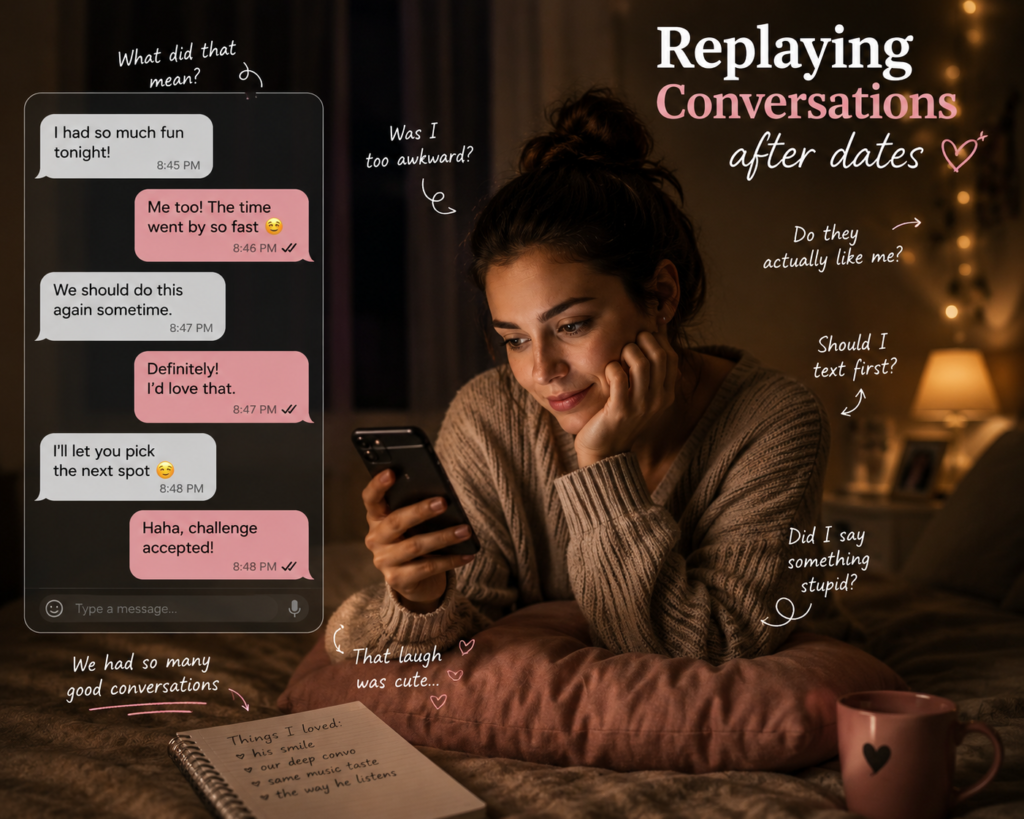
You get home from a date, and instead of relaxing, your mind starts running the tape back — that thing you said that maybe came out wrong, the pause before they answered a question, the way they phrased something that could mean several different things. You replay it once, then again, examining it from slightly different angles each time, trying to land on a version of events that feels settled.
This habit is extremely common, and it has a clear set of psychological explanations behind it — none of which mean you’re overreacting or doing dating “wrong.”
Replaying Is the Brain’s Way of Processing Incomplete Information
A first or early date is, by nature, an information-gathering experience. You’re trying to determine several things at once — whether you’re attracted to this person, whether they seem interested in you, whether the conversation flowed naturally, whether this could go somewhere. That’s a lot of open questions to process in real time, during the date itself, while also trying to be present and engaged.
Replaying the conversation afterward is often your brain’s attempt to finish that processing work once you have more mental bandwidth to do it. It’s less “obsessive” than it feels — it’s closer to your mind doing after-the-fact analysis on information it didn’t have time to fully process while it was happening.
Social Interactions Are Naturally Prone to Post-Event Review
Psychologists have studied a related phenomenon called “post-event processing,” most commonly discussed in the context of social anxiety, where people replay social interactions afterward, scanning for mistakes or awkward moments. While this tends to be more intense in people with higher social anxiety, some degree of post-event review is a normal part of how most people process socially significant interactions — and a date, with its inherent evaluative stakes, is about as socially significant as interactions get.
This means replaying a date isn’t unique to anxious or overly self-critical people. It’s a broadly human response to an interaction that carried real emotional weight and uncertain outcome.
The Brain Prioritizes Unresolved Situations
There’s a well-documented psychological tendency, sometimes referred to as the Zeigarnik effect, where unfinished or unresolved tasks are remembered and mentally revisited more than completed ones. A date that ends without a clear resolution — no explicit confirmation of mutual interest, no defined next step — functions, psychologically, as an unfinished task. Your mind treats it the way it treats any open loop: worth returning to until some kind of resolution is reached.
This is part of why dates that end ambiguously tend to get replayed more than dates that end with clear, mutual enthusiasm (“that was great, let’s do this again soon”). The uncertainty itself is what keeps pulling your attention back, not necessarily how the date actually went.
Replaying Specific Moments Is a Search for Missed Signals
A lot of conversation-replaying isn’t random — it’s targeted. People tend to specifically zoom in on moments that felt ambiguous: a joke that didn’t land clearly, a question that got a short answer, a shift in energy that might have meant something or might have meant nothing. This targeted replaying is essentially your brain trying to extract more signal from a moment that originally felt inconclusive.
The problem is that this kind of retrospective analysis often can’t actually resolve the ambiguity, because the missing information — what the other person was actually thinking or feeling in that moment — was never available to you in the first place, and rereading the memory of it doesn’t create new data, even though it can feel like it might.
Self-Focused Replaying Versus Other-Focused Replaying
It’s worth noticing which direction your replaying tends to go. Some people mostly replay their own performance — worrying about what they said, how they came across, whether they talked too much or not enough. Others mostly replay the other person’s behavior — trying to interpret what their responses meant.
Self-focused replaying is often tied to self-consciousness or a fear of having made a bad impression, and tends to respond well to simply reminding yourself that most people are far less focused on your minor missteps than you assume — a phenomenon researchers call the “spotlight effect,” where we consistently overestimate how much others notice and remember about our behavior.
Other-focused replaying is more often tied to the uncertainty-resolution drive discussed above, and tends to respond better to accepting that the ambiguity may simply need more time or direct communication to resolve, rather than more internal analysis.
Why It’s More Intense After Dates You Cared About
Just like post-date anxiety, replaying tends to intensify in direct proportion to how much you liked the person. A date you’re indifferent about rarely gets replayed in detail, because there’s little emotional stake in getting the interpretation right. A date with someone you’re genuinely drawn to carries much higher perceived stakes, which naturally increases the mental energy devoted to analyzing it afterward.
This means frequent replaying, uncomfortable as it feels, is often simply a marker of genuine interest — not a sign that something is wrong with you or with how the date went.
When Replaying Becomes Counterproductive
Some degree of reflection after a date is normal and even useful — it can help you clarify your own feelings about someone, or notice a pattern worth paying attention to. It becomes counterproductive when it turns into repetitive looping that doesn’t generate any new insight or action, just the same handful of scenarios being reanalyzed on repeat without resolution.
A helpful gauge: if you’re generating a new thought or realization each time you revisit the date, that’s still productive reflection. If you’re simply replaying the same handful of moments with the same unresolved uncertainty each time, you’ve likely crossed into unproductive rumination, and further replaying probably won’t change the outcome.
How to Quiet the Replay Loop
A few approaches genuinely help reduce this pattern. Naming what you’re doing — “I’m replaying this because the ending felt ambiguous, not because something went wrong” — helps interrupt the automatic nature of the loop by giving it a clear, less alarming explanation.
Giving yourself a defined window for reflection (a few minutes right after the date, rather than an open-ended invitation to revisit it throughout the following days) can help contain the habit without suppressing it outright. And redirecting the energy toward something actionable — deciding whether you want a second date, or drafting a simple, low-pressure follow-up text — often resolves the mental loop faster than continued private analysis ever could, because it moves the situation from unresolved to in-progress.
The Takeaway
Replaying conversations after a date is an extremely common, well-explained psychological response — driven by the brain’s discomfort with unresolved situations, a natural drive to process socially significant interactions, and heightened attention to moments that felt ambiguous in the moment. It tends to intensify with genuine interest, not diminish it, which means the discomfort of replaying is often simply the cost of caring about someone new. Recognizing the pattern for what it is — normal processing, not a red flag — usually makes it easier to let the loop settle on its own.
Leave a Reply