

Your cart is currently empty!
What Emotional Safety Feels Like When Dating
Emotional safety gets mentioned constantly in conversations about healthy relationships, but it’s rarely defined in a way that’s actually useful in the moment. Most people know, in the abstract, that they want to feel emotionally safe with a partner — but when you’re sitting across from someone on a third date, trying to gauge whether that’s actually present, “emotional safety” can feel like a vague, almost unmeasurable concept.
It’s worth breaking down more concretely, because emotional safety is one of the strongest predictors of whether a relationship will actually work — far more predictive than chemistry, excitement, or even compatibility of interests.
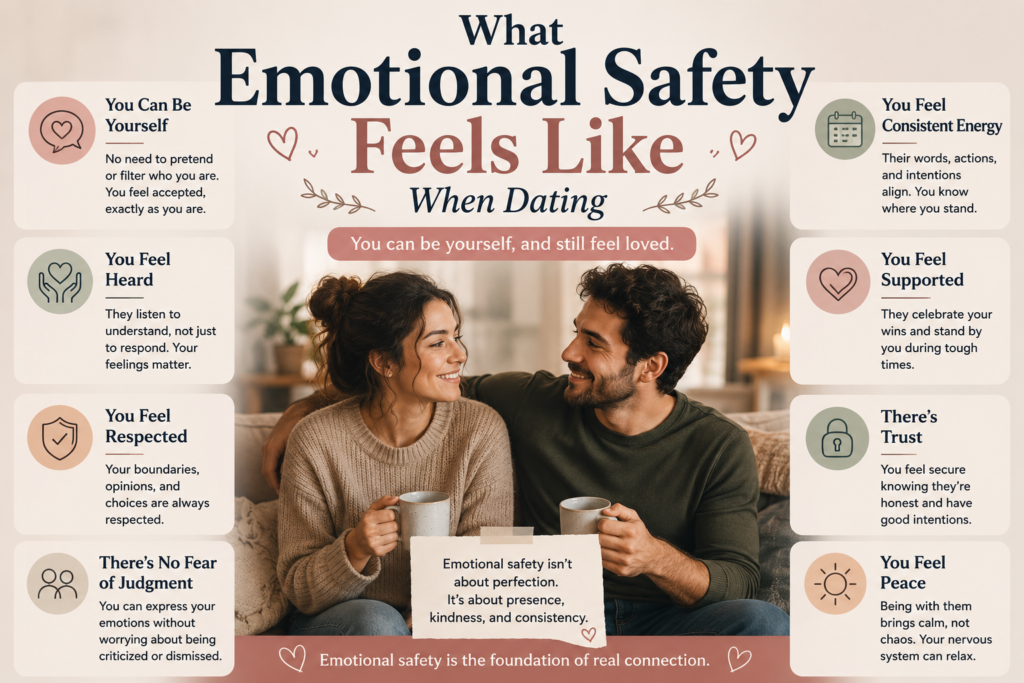
Emotional Safety Is the Ability to Be Honest Without Fear of Punishment
At its core, emotional safety means you can express a genuine thought, feeling, or need without expecting it to be met with anger, dismissal, guilt-tripping, or withdrawal of affection. This doesn’t mean every honest disclosure will be met with enthusiasm — it means it will be met with respect, even if the other person disagrees or feels differently.
In early dating, this often shows up in small ways: being able to say you’re not free on a specific night without the other person reacting with irritation, or being able to express mild disappointment about a canceled plan without it turning into a conflict or a guilt trip. These small tests, more than any single grand gesture, are where emotional safety actually gets established.
It Feels Like Being Met, Not Managed
One of the clearest markers of emotional safety is the difference between feeling met and feeling managed. Feeling met means when you express something, the other person engages with it directly — asking questions, validating the feeling, responding to what you actually said. Feeling managed means your feelings get redirected, minimized, or smoothed over in a way that prioritizes keeping things comfortable over actually engaging with what you shared.
Emotionally safe dynamics tend to involve real engagement, even when the topic is uncomfortable. Unsafe or avoidant dynamics tend to involve deflection — changing the subject, offering surface-level reassurance without addressing the actual concern, or subtly implying you’re overreacting.
Emotional Safety Includes Consistency Between Words and Actions
A person can say all the right things — “I really value honesty,” “you can tell me anything” — while their actual behavior doesn’t support it. Real emotional safety requires alignment between what someone says about how they’ll respond and how they actually respond when tested. If someone claims to welcome honesty but reacts with defensiveness or coldness the first time you’re honest about something difficult, that gap between stated values and actual behavior is more informative than the stated values themselves.
This is why emotional safety can’t really be assessed from words alone — it has to be observed through actual moments of vulnerability and how they’re received.
It Shows Up as a Physical Sense of Ease, Not Just a Mental Judgment
Emotional safety isn’t purely a cognitive assessment — it often registers physically, as a sense of relaxation in someone’s presence rather than a subtle, persistent tension. People who feel emotionally safe with a partner often describe being able to let their guard down, speak without heavily editing themselves first, or simply exist quietly together without needing to perform or manage the other person’s mood.
The opposite — feeling like you have to monitor your tone, choose your words carefully to avoid a negative reaction, or constantly gauge someone’s mood before saying something honest — is a physical signal worth paying attention to, even if you can’t immediately articulate why the dynamic feels uncomfortable.
Emotional Safety Doesn’t Mean an Absence of Conflict
A common misconception is that emotional safety means never disagreeing or never experiencing friction. In reality, emotionally safe relationships still involve conflict — the safety isn’t in avoiding disagreement, it’s in how disagreement gets handled. Can both people express frustration without it escalating into contempt or stonewalling? Can a disagreement be resolved without either person feeling like their perspective was dismissed or punished for existing?
Relationships that avoid all visible conflict aren’t necessarily safer — sometimes they simply reflect one or both people suppressing honest reactions to keep the peace, which is a different (and less sustainable) dynamic than genuine safety.
How Emotional Safety Develops Over Time
Emotional safety isn’t something that’s fully present or absent from the first date — it builds gradually, through a series of small tests where vulnerability is met with a reasonably safe response. Early on, this might mean noticing how someone responds to a minor disappointment or a small piece of honest feedback. Over time, as bigger vulnerabilities get shared and met with consistent respect, emotional safety deepens.
This gradual development is actually a healthy sign, not a red flag. Trying to establish full emotional safety too quickly — through intense early vulnerability before enough evidence has accumulated — can sometimes bypass the natural, protective pacing that allows real trust to form on solid footing.
Signs Emotional Safety Might Be Missing
A few patterns are worth paying attention to as potential signs that emotional safety isn’t fully present: feeling like you need to filter or manage what you say to avoid a negative reaction; noticing that expressing a need or boundary is met with guilt, withdrawal, or subtle punishment; feeling more anxious after honest conversations rather than more connected; or noticing that the other person rarely, if ever, shows their own vulnerability in return, keeping the emotional exposure one-sided.
None of these signs alone are necessarily dealbreakers, especially early on when both people are still building trust. But a consistent pattern across several of them is worth taking seriously as information about the relationship’s foundation.
Why Emotional Safety Matters More Than Chemistry Long-Term
Chemistry can create initial pull, but emotional safety is what actually allows a relationship to deepen past the early stages into real intimacy. Without it, vulnerability starts to feel risky rather than natural, which limits how close two people can actually become, regardless of how strong the initial attraction was. Relationships with strong chemistry but weak emotional safety often plateau at a surface level of connection, or become characterized by walking on eggshells rather than genuine ease.
How to Build (and Recognize) Emotional Safety Yourself
Emotional safety is co-created, which means it’s also worth reflecting on how safe you make a partner feel to be honest with you. Responding to a partner’s honesty with curiosity rather than defensiveness, resisting the urge to punish vulnerability even when it’s uncomfortable to hear, and being consistent in how you respond to honesty over time all contribute to building the kind of mutual safety that allows a relationship to actually deepen.
The Takeaway
Emotional safety in dating isn’t an abstract, unmeasurable quality — it shows up concretely in how someone responds when you’re honest, whether their actions match their stated values, and whether being around them produces ease rather than quiet vigilance. It develops gradually, through repeated small moments rather than one dramatic test, and it matters more for a relationship’s long-term health than chemistry or excitement ever will. Paying attention to it early, and taking it seriously as a real factor in your decision-making, is one of the most reliable ways to build a relationship that can actually last.
Leave a Reply