
Your cart is currently empty!
Why Dating Apps Make People Doubt Themselves
It’s a common enough experience that it’s become something of a cultural shorthand: someone starts using dating apps feeling reasonably confident, and after months of swiping, matching, and messaging, finds their self-esteem noticeably lower than when they started — even if nothing dramatically bad happened along the way. No single terrible date, no cruel message, just a slow erosion that’s hard to pin to any one moment.
This isn’t an accident or a coincidence. Dating apps are built on mechanics that, while not intentionally designed to harm self-esteem, tend to produce exactly that effect over sustained use. Understanding the mechanics helps explain why this happens — and makes it easier to protect yourself from it.
Apps Turn People Into a Continuous Evaluation Loop
Traditional dating, whether through friends or chance meetings, typically involves being evaluated by one person at a time, in a context that includes personality, humor, and presence — not just appearance in a photo. Dating apps compress that evaluation into a rapid-fire visual assessment, repeated dozens or hundreds of times, often based on a handful of photos and a short bio.
Being evaluated this frequently, this quickly, and this narrowly (visually, without the context a real interaction provides) is a fundamentally different psychological experience than traditional dating. Repeated exposure to rapid judgment — even when it’s not explicitly communicated, just implied through a lack of matches or responses — tends to wear down self-perception over time, simply through sheer volume of subtle rejection.
The Feedback Is Ambiguous, Which Makes It Worse
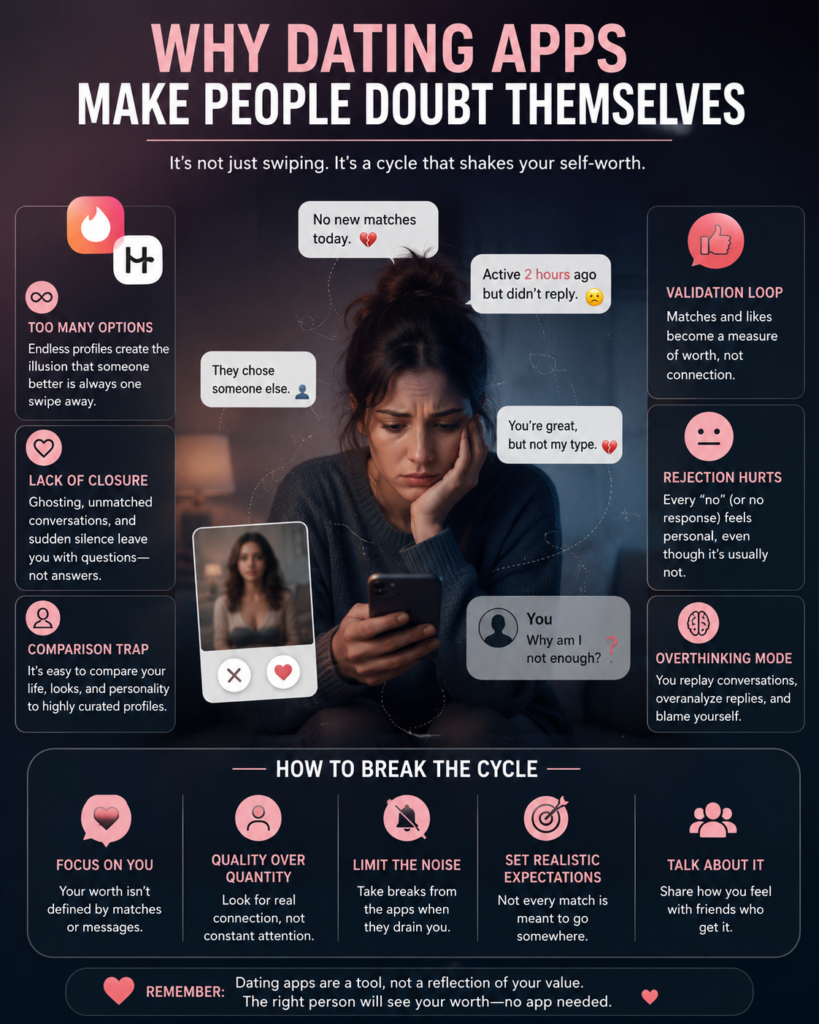
One particularly corrosive feature of app-based rejection is its ambiguity. A lack of matches or a lack of replies doesn’t come with an explanation — you don’t know if it’s about your photos, your bio, timing, algorithm placement, or simply the other person’s mood that day. In the absence of a clear explanation, the mind tends to fill the gap with the most self-critical interpretation available, often generalizing a lack of response into a broader statement about desirability or worth.
This is worse, psychologically, than clear rejection with a reason attached. Ambiguous rejection is harder to contextualize and easier to internalize as a reflection of something fundamentally lacking, rather than attributing it to any of the many mundane, non-personal explanations that are just as likely to be true.
Quantification Encourages Harmful Comparison
Dating apps often quantify romantic interest in visible ways — number of matches, number of likes, response rates — turning something inherently personal and subjective into something that feels measurable and comparable. This quantification invites a kind of self-evaluation that doesn’t map well onto real self-worth: fewer matches than expected can start to feel like objective evidence of lower desirability, even though match counts are influenced by algorithm behavior, timing, location, and platform demographics far more than by someone’s actual value as a partner or person.
This dynamic is similar to how quantified social media metrics (likes, followers) have been shown to affect self-esteem — the presence of a visible number transforms an abstract, hard-to-measure quality into something that feels concretely comparable, which tends to amplify insecurity rather than provide useful information.
The Sheer Volume of Rejection Is Historically Unusual
Prior to dating apps, most people experienced romantic rejection relatively infrequently — a handful of times across years of dating, through direct, personal interactions. Dating apps have compressed that experience into something that can happen dozens of times a week, often silently and without explanation. Human psychology wasn’t built to process rejection at that frequency, and repeated exposure — even to low-stakes, impersonal rejection — has a cumulative effect on self-esteem that’s rarely accounted for in casual conversations about app fatigue.
Curated Profiles Create Unrealistic Comparison Points
Just as social media encourages comparison to curated, idealized versions of other people’s lives, dating app profiles are inherently curated — showing the most flattering photos, the wittiest bio lines, the most impressive highlights. Comparing your actual, unfiltered self against a stream of other people’s most polished self-presentation creates an unfair comparison that can quietly erode confidence, even though you’re not comparing like for like.
This effect compounds the longer someone uses the apps, since the sheer volume of curated profiles seen over time creates an increasingly skewed sense of what “normal” or “average” looks like in the dating pool.
Ghosting and Non-Responses Compound the Effect
The casual, low-accountability nature of app-based communication has normalized behaviors like ghosting — disappearing without explanation after conversation or even dates — at a scale that wouldn’t have been socially acceptable in most pre-app dating contexts. Repeated exposure to this kind of unexplained disengagement, again without any clear reason attached, feeds directly into the ambiguous-rejection cycle discussed earlier, reinforcing self-doubt through a steady drip of unresolved, unexplained non-responses.
Why This Doesn’t Mean Something Is Wrong With You
It’s worth stating plainly: if dating apps have eroded your confidence, that’s a predictable response to the structural mechanics of the format, not evidence that something is actually wrong with your desirability or worth. The same person who might struggle to get matches on an app could have an entirely different experience meeting people in person, where personality, humor, and presence — qualities apps struggle to convey — have much more room to come through.
This distinction matters because a lot of app-induced self-doubt gets internalized as a personal truth (“I must not be that likable”) rather than recognized as an artifact of a specific, flawed evaluation system.
How to Protect Your Self-Esteem While Using Apps
A few practical adjustments can reduce the psychological toll. Limiting time spent on apps, rather than treating them as a constant background activity, reduces the cumulative volume of ambiguous rejection you’re exposed to. Consciously resisting the urge to attach personal meaning to match counts or response rates — reminding yourself these numbers are influenced by algorithms and circumstance far more than by your actual worth — helps interrupt the comparison spiral.
It also helps to actively balance app-based dating with other forms of meeting people, and to remember that in-person interactions provide a much fuller, fairer picture of who you are than a handful of photos ever could. If you notice your self-esteem consistently dropping the longer you use a given app, that’s worth taking as real information — a signal to step back and reset, rather than push through and hope the feeling resolves on its own.
The Takeaway
Dating apps make people doubt themselves not because of any personal failing, but because of well-documented structural features: rapid, repeated evaluation; ambiguous rejection that invites self-critical interpretation; quantified metrics that encourage unhealthy comparison; and a historically unusual volume of low-stakes rejection concentrated into a short period of time. Recognizing these mechanics for what they are — features of the format, not accurate reflections of your worth — is one of the most protective things you can do for your self-esteem while dating in an app-driven landscape.
Leave a Reply