

Your cart is currently empty!

Is It Normal to Feel Attached Quickly?
You’ve had a handful of dates with someone, and already you find yourself thinking about them more than seems reasonable, feeling genuinely disappointed at the idea of it not working out, or noticing a level of emotional investment that feels disproportionate to how little time you’ve actually spent together. It can be disorienting — is this real connection, or is something off about how quickly you’re getting attached?
The honest answer is that fast attachment is common, and it isn’t automatically a red flag — but it also isn’t automatically safe, and understanding the difference matters more than simply labeling the experience as normal or not.
Fast Attachment Isn’t Inherently Abnormal
Emotional attachment doesn’t operate on a fixed, universal timeline. Some people form emotional bonds relatively quickly by nature — a trait that’s not inherently unhealthy, especially if it’s paired with reasonably accurate judgment about the person they’re attaching to. Quick attachment becomes more concerning not because of its speed, but because of what it’s based on: whether it’s grounded in real, observed qualities, or built primarily on projection, hope, and the story you’ve constructed about who this person might be.
This distinction — attachment based on evidence versus attachment based on projection — is more useful than simply asking whether the timeline itself is “too fast.”
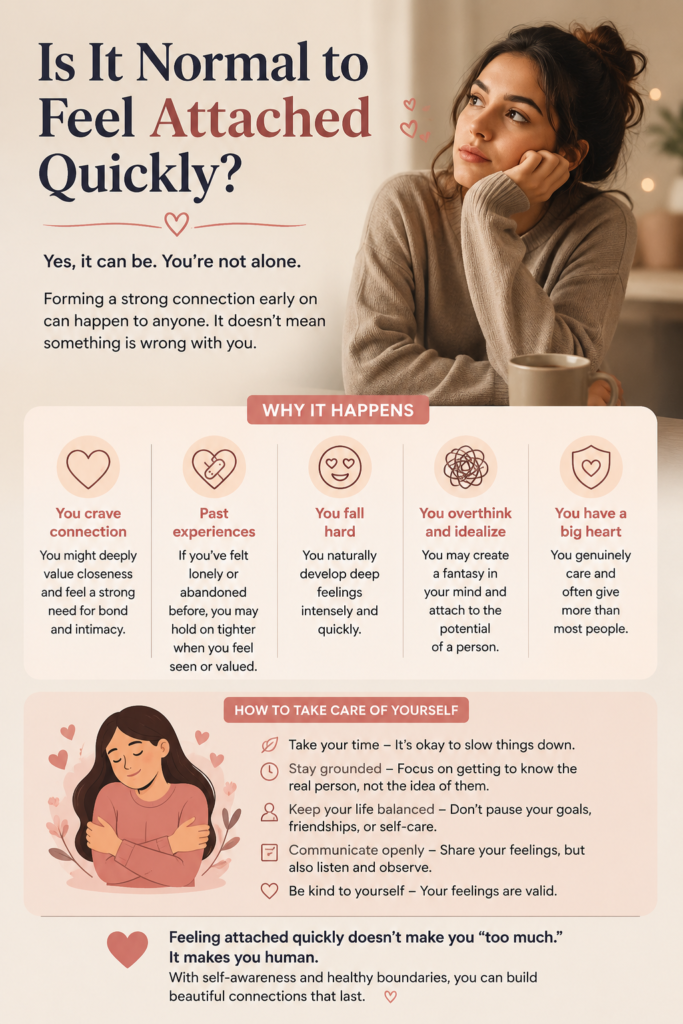
What Drives Fast Attachment Psychologically
A few factors commonly contribute to rapid attachment. Intense early communication — long conversations, frequent texting, quick escalation of emotional disclosure — can accelerate a sense of closeness faster than the actual amount of time spent together would typically produce. This isn’t necessarily manipulative; it can happen organically when two people genuinely enjoy talking to each other and communicate frequently early on.
Attachment style also plays a significant role. People with more anxious attachment tendencies often report forming attachments more quickly and intensely, partly because their nervous system is more attuned to closeness and more sensitive to the possibility of connection, activating attachment-related feelings earlier than someone with a more secure or avoidant style might experience.
Loneliness or a period of significant life transition can also accelerate attachment, since the emotional need for connection is heightened, making a new relationship feel more significant, more quickly, than it might during a more emotionally stable period.
The Difference Between Attachment to a Person and Attachment to a Possibility
One of the more important distinctions to make is whether you’re attached to the actual person — their specific, observed qualities, how they’ve treated you, real evidence gathered over your interactions — or attached to the possibility of who they could become, the relationship you’re imagining, or the relief of finally feeling chosen after a period of loneliness or disappointment.
Attachment to a possibility tends to be less stable and more vulnerable to disappointment, because it isn’t grounded in accurate information — it’s grounded in hope and projection, which can diverge significantly from reality as more information becomes available. Attachment to a real, observed person is more likely to hold up over time, because it’s based on evidence rather than imagination.
Fast Attachment and Relationship Outcomes
Research on relationship formation doesn’t suggest that fast attachment automatically predicts worse outcomes, but it does suggest that attachment formed primarily through intensity — rather than through consistent, observed behavior over time — is more fragile and more prone to sudden collapse once reality doesn’t match the constructed narrative. This is part of why relationships that move very fast, particularly ones fueled by intense early communication and idealization, sometimes end abruptly once the idealized version of the person meets the more complicated reality of who they actually are.
This doesn’t mean fast-forming relationships can’t work — plenty do. It means the speed of attachment isn’t, by itself, informative about the relationship’s health; what matters more is whether the attachment is being continuously checked against real, accumulating evidence, or allowed to run ahead of it.
When Fast Attachment Is Worth Examining More Closely
A few patterns are worth paying closer attention to if you notice them alongside fast attachment: feeling attached despite relatively little actual time spent together or getting to know the person in varied contexts; noticing that your attachment seems to intensify specifically during periods of uncertainty or inconsistency from the other person (a pattern sometimes associated with anxious attachment dynamics, where uncertainty itself can intensify emotional investment); or realizing that your attachment doesn’t seem to be updating in response to new information, even information that would reasonably give you pause.
These patterns don’t necessarily mean anything is wrong with you, but they’re worth reflecting on honestly, since they suggest the attachment may be running ahead of the actual evidence available.
When Fast Attachment Is a Healthy Sign
On the other hand, fast attachment that’s accompanied by consistent, observed positive behavior — someone who has shown up reliably, communicated honestly, and treated you well across a range of situations, even in a relatively short time — is a different and generally healthier picture. Attachment forming quickly in response to genuinely good, consistent treatment isn’t a red flag; it’s simply your emotional system accurately responding to positive, trustworthy signals.
The speed of attachment matters less than its foundation. Quick attachment built on real evidence is fundamentally different from quick attachment built on hope, and the two can feel identical from the inside, which is exactly why it’s worth examining rather than assuming.
How to Navigate Fast Attachment Responsibly
If you notice yourself attaching quickly, a useful practice is deliberately slowing down your interpretation, even if your feelings themselves are moving fast. This might mean consciously reminding yourself how much you actually know about this person versus how much you’re inferring or hoping, or intentionally continuing to observe their behavior across a range of situations before fully trusting the attachment as an accurate reflection of compatibility.
It also helps to maintain other areas of your life — friendships, hobbies, personal goals — so that a new attachment doesn’t become the sole source of emotional stability, which tends to intensify attachment speed in a way that’s more about filling a gap than accurately assessing the relationship.
The Takeaway
Feeling attached quickly is common and not inherently a problem — but it’s worth examining what the attachment is actually based on. Attachment grounded in real, observed, consistent behavior tends to be a healthy response to genuine compatibility. Attachment grounded primarily in hope, projection, or the relief of feeling chosen is more fragile and worth approaching with more caution and self-awareness. The speed itself isn’t the concerning part; what matters is whether your feelings are keeping pace with actual evidence, or running ahead of it.
Leave a Reply