

Your cart is currently empty!
Why Dating Feels Harder the More You Care
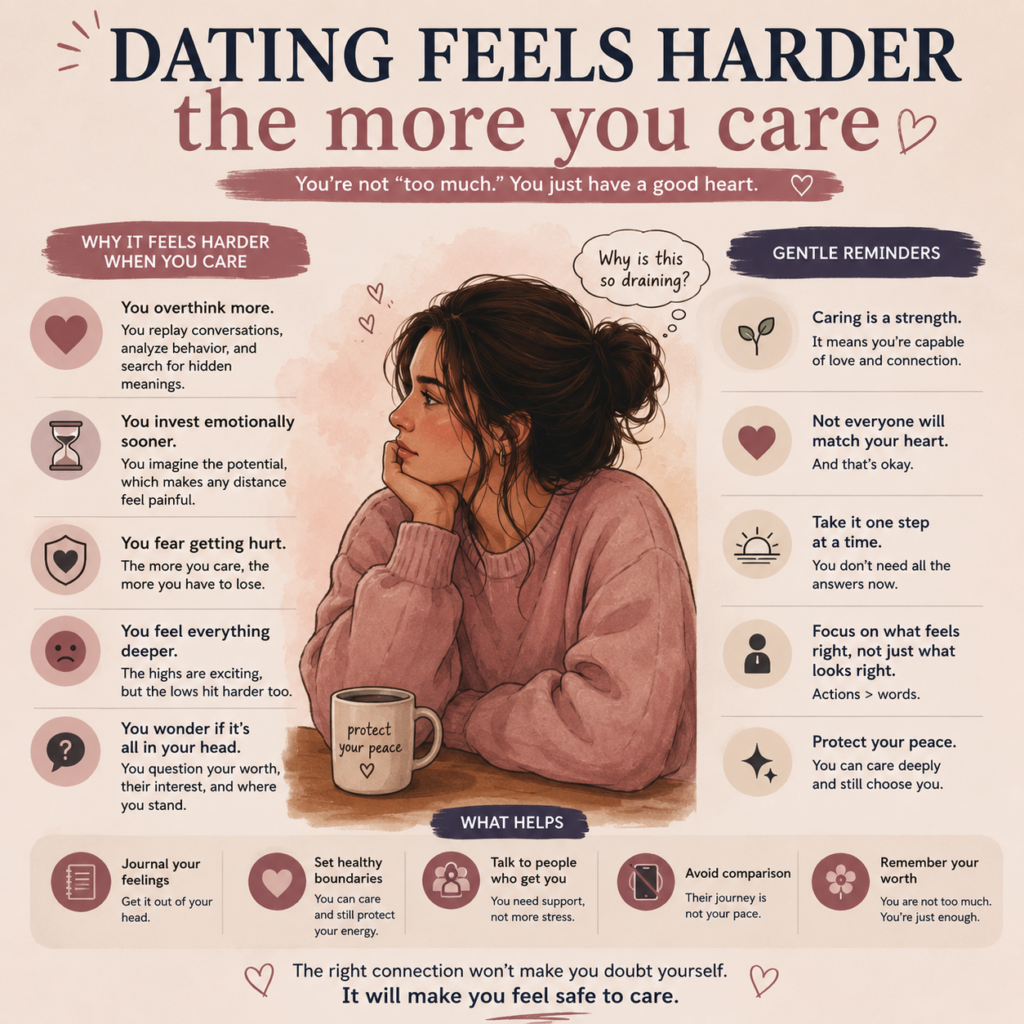
There’s a counterintuitive pattern many people notice once they’ve dated enough to see it clearly: the connections that matter the least tend to feel the easiest, while the ones you actually care about tend to feel the hardest. You can navigate a date you’re indifferent about with total ease — relaxed, unbothered, quick to move on if it doesn’t go anywhere. But the moment real interest enters the picture, everything gets more complicated: more overthinking, more anxiety, more difficulty just being yourself.
This pattern isn’t a coincidence, and it isn’t a sign that you’re bad at dating or self-sabotaging. It reflects a very consistent psychological principle: increased investment increases perceived risk, and increased risk increases difficulty.
Low Stakes Create the Illusion of Ease
When you don’t care much about an outcome, you have very little to lose, which naturally reduces anxiety, self-monitoring, and emotional reactivity. This is why so many people report their most “natural” and confident dating behavior happening with people they weren’t particularly invested in — not because they were behaving better, but because the absence of real stakes removed the pressure that usually complicates things.
This creates a misleading impression that ease equals health, and difficulty equals dysfunction. In reality, ease in low-stakes situations doesn’t reflect skill or emotional maturity so much as it reflects the simple fact that there was little to protect.
Caring Introduces the Possibility of Real Loss
Once you genuinely like someone, the relationship stops being a neutral experience and starts carrying real emotional weight — the possibility of rejection now means something, the outcome now matters, and your nervous system responds accordingly. This shift is often experienced as increased anxiety, increased self-consciousness, and a harder time simply relaxing into the interaction the way you might with someone you’re indifferent about.
This isn’t dysfunction — it’s an accurate emotional response to genuinely elevated stakes. Wanting something you might not get is, almost by definition, harder than being indifferent to an outcome either way.
The Fear of Losing Something Distorts Behavior
As investment increases, so does the temptation to manage the outcome — overanalyzing texts, adjusting your behavior to seem more appealing, softening honest opinions to avoid risking the connection. This isn’t a character flaw; it’s a predictable response to caring about an outcome you don’t fully control. But it can create a frustrating paradox: the more you care, the more your behavior can shift away from the natural, authentic version of yourself that likely made the connection appealing in the first place.
Recognizing this pattern is useful, because it explains why people sometimes feel like their “best self” shows up with people they don’t care about, and a more anxious, edited version of themselves shows up with people who actually matter to them — it’s not that caring makes you worse at dating, it’s that caring introduces pressure that can distort otherwise natural behavior.
Past Disappointment Adds to the Difficulty
For people who have been hurt in past relationships, caring about someone new can activate not just present-day vulnerability but old, unresolved fear from previous experiences. This compounding effect can make caring feel disproportionately difficult — not just because of what’s happening now, but because it reopens emotional terrain from past disappointment that hasn’t been fully processed.
This is worth naming because it reframes the difficulty: it’s often not really about the current person or situation being uniquely hard, but about old wounds getting activated by the vulnerability that genuine caring requires.
Wanting Something Removes the Safety Net of Detachment
Detachment, whether intentional or circumstantial, functions as a kind of emotional safety net — if you don’t care much, you can’t be hurt much. Genuine investment removes that safety net, which is exactly why it feels harder, even though nothing about the actual person or situation has necessarily become more complicated. The difficulty lives in the vulnerability itself, not in the specific circumstances of the relationship.
This is an important distinction, because it means the difficulty you’re experiencing when you really like someone isn’t necessarily a signal that something is wrong — it’s often simply the emotional cost of genuine investment, which is a very different thing from a red flag about the relationship’s viability.
Why This Makes People Second-Guess Good Connections
A particularly unhelpful side effect of this pattern is that people sometimes interpret the increased difficulty of caring as evidence that the connection itself must be wrong — reasoning that if this were truly right, it would feel easier, the way low-stakes dating did. This reasoning is backwards. Difficulty that arises from genuine investment isn’t evidence against a connection’s rightness; it’s often simply evidence that the connection matters, which introduces a kind of vulnerability that indifferent dating never required.
Confusing “this is hard because I care” with “this is hard because it’s wrong” is one of the more common ways people talk themselves out of relationships that were actually going reasonably well, simply because the emotional difficulty of real investment felt unfamiliar or uncomfortable.
How to Manage the Difficulty Without Suppressing the Caring
The goal isn’t to protect yourself from difficulty by caring less — that trade tends to produce a hollow, safer-feeling but less meaningful dating life. The more useful goal is learning to tolerate the discomfort that comes with genuine investment, without letting it distort your behavior or your judgment.
This can include consciously separating anxious, protective impulses (overanalyzing, editing yourself, seeking excessive reassurance) from your authentic reactions, and reminding yourself that difficulty rooted in caring is a normal, even healthy, sign that you’re engaging honestly — not a reason to retreat into detachment or read the difficulty as a verdict on the relationship’s worth.
The Takeaway
Dating feels harder the more you care because caring genuinely does increase what’s at stake — introducing real vulnerability, real potential for loss, and real pressure that low-investment dating never requires. This difficulty isn’t a sign that something is wrong with the relationship, and it isn’t a sign that something is wrong with you. It’s the predictable emotional cost of genuine investment, and learning to tolerate it — rather than retreating into detachment or mistaking it for a red flag — is one of the more important skills for building a relationship that actually matters.
Leave a Reply