

Your cart is currently empty!
Should I Keep Dating Someone Who Is Inconsistent?
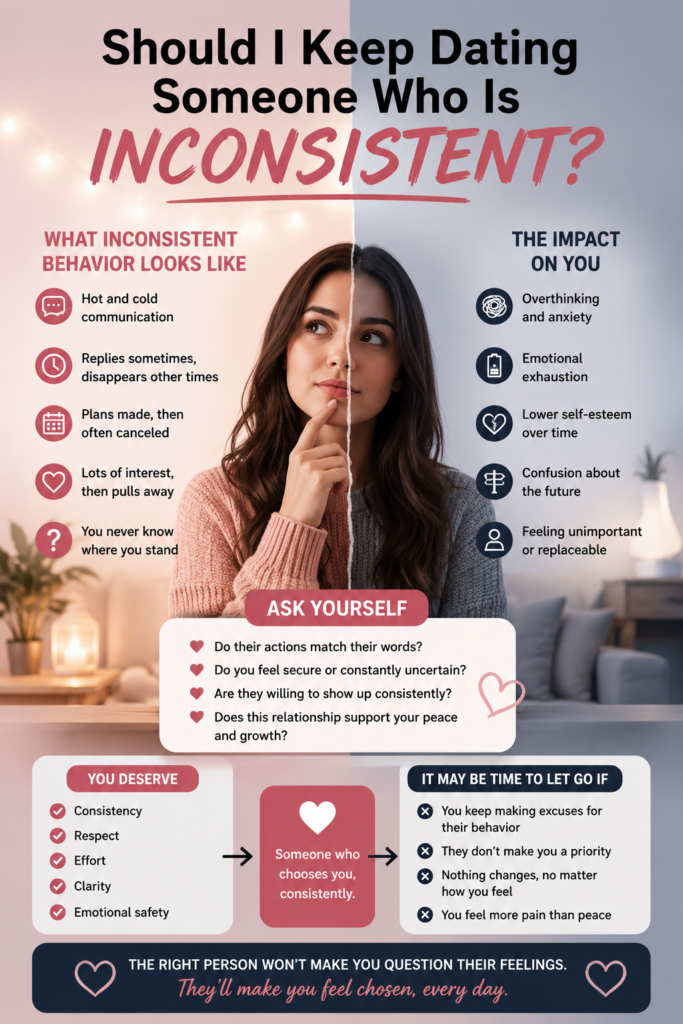
Inconsistency is one of the most common — and most confusing — patterns in early dating. Someone seems genuinely interested one week, distant the next, warm again after that. Unlike a clear red flag or a clean rejection, inconsistency doesn’t offer a decisive moment to walk away. It keeps you in a state of uncertainty, hoping the good version is the “real” one, wondering if patience will eventually be rewarded with stability.
There’s no universal answer to whether you should keep dating someone inconsistent — it genuinely depends on the specifics. But there is a clearer way to think through the decision than simply waiting and hoping.
Distinguish Between Inconsistency and Normal Variation
Before addressing genuine inconsistency, it’s worth ruling out normal variation, which can look similar on the surface. Everyone has fluctuating energy, busy weeks, and periods where they’re less available — this is normal and doesn’t necessarily reflect fluctuating interest. Genuine inconsistency, by contrast, tends to involve a pattern that’s disconnected from any reasonable external explanation: enthusiasm and distance that alternate without any apparent cause, rather than dips that correlate with an identifiable busy period or stressor.
If someone’s fluctuations track logically with their actual life circumstances, that’s likely normal variation. If the pattern seems to shift unpredictably, without any explanation that accounts for it, that’s more likely genuine inconsistency worth examining further.
Consider Whether the Inconsistency Is Improving, Stable, or Worsening
A useful diagnostic question is whether the pattern is trending in any particular direction. Some early inconsistency, especially in the first few weeks of dating, can genuinely resolve as two people build more trust and settle into a more stable rhythm — this is common enough that early inconsistency alone isn’t necessarily a reason to end things. What’s more concerning is inconsistency that persists at the same level over a longer period, or that gets worse over time despite the relationship otherwise progressing. Persistent or worsening inconsistency, especially after enough time has passed for early-stage nerves to settle, is a stronger signal that something more fundamental is at play.
Ask What’s Driving the Inconsistency, If You Can Find Out
As discussed in the broader conversation about people pulling back, inconsistency can stem from a range of causes — fear of vulnerability, genuine ambivalence, external stress, or simply incompatible communication styles. If you have the opportunity to ask directly and get an honest, self-aware answer (“I’ve noticed I get anxious about getting close to people and sometimes pull back without meaning to”), that kind of insight can meaningfully change the calculus. Someone who’s aware of their pattern and actively working on it is a different situation than someone who either can’t or won’t acknowledge the inconsistency at all.
If direct questions consistently produce vagueness, defensiveness, or denial that the pattern even exists, that’s itself useful information — suggesting either a lack of self-awareness or a lack of willingness to engage honestly about the dynamic, either of which makes sustained change less likely.
Weigh the Emotional Cost Against the Potential Upside
Even if there’s a plausible, sympathetic explanation for someone’s inconsistency, it’s worth honestly assessing what staying is costing you emotionally. Chronic uncertainty is genuinely taxing — the anxious monitoring, the unpredictable highs and lows, the mental energy spent trying to interpret someone’s shifting behavior. Even a sympathetic explanation doesn’t eliminate that cost; it just contextualizes it.
A fair question to ask yourself: if this pattern continues exactly as it has been for another six months, would the relationship still feel worth it? If the honest answer is no, that’s valuable information regardless of how understandable the other person’s inconsistency might be.
Consider Whether You’re the Only One Adjusting
A common dynamic in inconsistent relationships is one person quietly adjusting their expectations, communication style, and emotional availability to accommodate the other’s unpredictability, while the inconsistent partner makes little effort to address the pattern themselves. If you notice you’re the one consistently absorbing the emotional impact of the inconsistency — managing your own anxiety, moderating your expectations, avoiding bringing up the pattern to keep the peace — while the other person’s behavior remains unchanged, that imbalance is worth naming directly, ideally before deciding whether to continue.
When Inconsistency Is a Clear Reason to Walk Away
Some patterns of inconsistency are serious enough to warrant ending things regardless of the underlying explanation. This includes inconsistency paired with dishonesty (contradicting their own previous statements, being caught in lies about availability or other relationships), inconsistency that’s used to maintain control (deliberately creating uncertainty to keep you invested without offering real commitment), or inconsistency that consistently leaves you feeling worse about yourself over time, regardless of the specific explanation offered.
In these cases, the underlying cause matters less than the pattern’s effect: a relationship that consistently erodes your wellbeing isn’t worth maintaining simply because there’s a sympathetic-sounding reason behind the behavior.
When It Might Be Worth Continuing, With Boundaries
If the inconsistency seems to stem from genuine, acknowledged struggle (rather than manipulation or dishonesty), if the person shows some willingness to engage honestly about the pattern, and if you have the emotional bandwidth to continue without it seriously affecting your wellbeing, it may be reasonable to continue dating while setting clear expectations. This might look like directly communicating what you need (“I need more predictable communication to feel secure in this”) and giving a reasonable, defined amount of time to see whether meaningful change actually follows, rather than indefinitely tolerating the same pattern without any boundary at all.
Trust the Pattern Over Any Single Good Moment
Regardless of which direction you lean, it’s worth resisting the pull of any single particularly good moment — a great date, a especially warm conversation — to override an otherwise consistent pattern of inconsistency. Good moments are real, but they don’t erase the pattern; they’re simply part of what makes the pattern so difficult to walk away from in the first place. The overall pattern across weeks and months is a far more reliable guide to the relationship’s real trajectory than how things feel on any single good day.
The Takeaway
Whether to keep dating someone inconsistent depends on distinguishing normal variation from genuine inconsistency, assessing whether the pattern is improving or worsening, understanding (if possible) what’s actually driving it, and honestly weighing the emotional cost against the relationship’s potential. There’s no universal rule, but there is a clear principle: sympathetic explanations for inconsistency don’t obligate you to keep absorbing its emotional cost indefinitely. The pattern itself, more than any single good or bad moment, is the most reliable guide to whether staying is likely to be worth it.
Leave a Reply