

Your cart is currently empty!
Why Dating Excitement Turns Into Anxiety
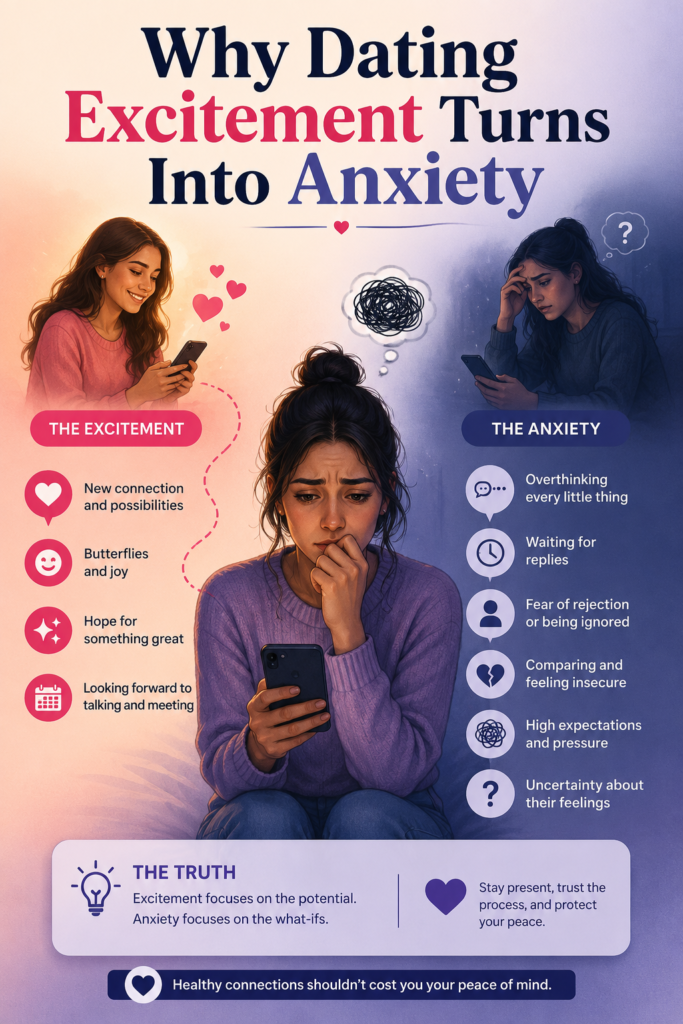
The beginning of a promising new connection often starts with genuine excitement — anticipation, lightness, a sense of possibility. But for many people, that excitement doesn’t stay pure for long. It gradually, or sometimes suddenly, shifts into something closer to anxiety — a persistent undertone of worry that shadows the same excitement that started things off.
This shift is extremely common, and understanding why it happens can help you hold both feelings without letting the anxiety completely overtake the excitement that got you here in the first place.
Excitement and Anxiety Share the Same Physiological Root
One of the more surprising facts about this shift is that excitement and anxiety are, physiologically, very similar states. Both involve elevated heart rate, increased alertness, and heightened arousal of the nervous system. The primary difference between the two isn’t the physical sensation itself but how the mind labels and interprets that sensation — as positive anticipation, or as threat.
This means the transition from excitement to anxiety isn’t necessarily a dramatic internal shift; it can be a fairly subtle reinterpretation of the same underlying physical state, triggered by a change in how safe or uncertain the situation starts to feel.
Increased Investment Increases Perceived Stakes
As a connection develops and genuine investment grows, the potential cost of losing it grows alongside it. Early excitement often exists in a lower-stakes phase — you like the possibility, but you haven’t yet built much real attachment. As real feelings develop, so does the fear of disappointment, and that fear can gradually convert what started as pure excitement into a more anxious, protective form of anticipation.
This shift is, in a sense, a natural consequence of caring more. The excitement hasn’t disappeared — it’s often still there, layered underneath the anxiety — but the added weight of genuine investment introduces a new emotional dimension that pure excitement, on its own, didn’t need to account for.
Uncertainty Compounds Over Time, Not Just at the Start
Early dating excitement often coexists with a kind of blissful ignorance — you don’t yet know enough about the situation to have specific worries. As more time passes without full clarity — about exclusivity, about long-term compatibility, about where things are actually headed — that accumulated uncertainty starts to weigh more heavily. What began as excitement about pure possibility gradually accumulates unresolved questions, and each unresolved question adds a small amount of anxiety to the overall experience.
This is part of why the anxiety often intensifies over the first several weeks of a promising connection, rather than immediately at the start — it builds as uncertainty accumulates, rather than announcing itself all at once.
Past Experience Primes the Anxiety Response
For people who have been disappointed or hurt in past relationships, genuine excitement about a new connection can trigger an almost automatic anticipatory anxiety — a kind of bracing for the pattern to repeat itself. This isn’t necessarily a conscious thought process; it’s often a learned emotional response where positive romantic feelings have, in the past, preceded painful outcomes, creating an association between excitement and eventual disappointment that resurfaces even in genuinely different, healthier situations.
This pattern is worth naming explicitly, because it reframes the anxiety not as an accurate prediction about the current relationship, but as a learned protective response carried over from previous experience — one that may or may not actually apply to what’s happening now.
The Fear of Jinxing Something Good
A less clinical but very common explanation is a kind of superstitious anxiety — a fear that acknowledging or fully enjoying the excitement will somehow “jinx” it, or that allowing yourself to feel hopeful sets you up for a harder fall if things don’t work out. This fear often manifests as a kind of self-protective anxiety that shows up specifically in response to things going well, functioning almost as an attempt to pre-emotionally brace for disappointment before it happens, in order to reduce its impact if it does.
While this strategy is understandable, it rarely actually protects against disappointment — it mostly just adds anxiety to the present moment, in exchange for a modest, uncertain reduction in future pain that may never even materialize.
Excitement Naturally Draws Attention to What Could Go Wrong
There’s a specific cognitive pattern where positive anticipation makes people more attentive to potential threats to that positive outcome — a kind of heightened vigilance aimed at protecting something valuable. This is part of why excitement about a promising relationship often comes bundled with increased attention to any sign of trouble, any hint of inconsistency, any small thing that could threaten the connection. That heightened vigilance, while understandable, is itself a source of anxiety, since it keeps your attention scanning for potential problems even when none are actually present.
How to Hold Both Feelings Without Letting Anxiety Take Over
The goal isn’t to eliminate the anxiety entirely — some anxiety accompanying genuine investment is normal and, in a sense, unavoidable. The goal is to prevent it from overtaking or erasing the excitement that’s still legitimately present underneath it. This can include consciously naming both feelings when they show up together (“I’m excited about this and also a little anxious, and both of those are okay to feel at once”), rather than letting the anxiety dominate the narrative simply because it’s the more urgent-feeling of the two emotions.
It also helps to gently challenge the specific worries driving the anxiety — asking whether they’re based on actual evidence from this relationship, or imported from past experience or general uncertainty about the unknown. And it helps to resist the superstitious instinct to withhold enjoyment of the excitement as a form of protection — that strategy rarely actually reduces future pain, and it does reliably reduce present enjoyment of something that, so far, may be going genuinely well.
The Takeaway
The shift from dating excitement to anxiety is a common, well-explained pattern — rooted in the physiological overlap between excitement and anxiety, increased perceived stakes as investment grows, accumulating uncertainty over time, and learned protective responses from past experience. Recognizing this pattern doesn’t make the anxiety disappear, but it does make it easier to hold alongside the excitement, rather than letting it quietly take over and overshadow a connection that, underneath the anxious layer, may genuinely still be something worth feeling good about.
Leave a Reply