

Your cart is currently empty!
Is It Okay to Feel Vulnerable While Dating?
There’s a common instinct in dating to treat vulnerability as something to manage, minimize, or hide — a sign of weakness that needs to be concealed behind a more composed, guarded exterior. Feeling exposed, uncertain, or emotionally open can trigger a kind of embarrassment, as though the vulnerability itself is a mistake rather than a normal part of getting close to someone new.
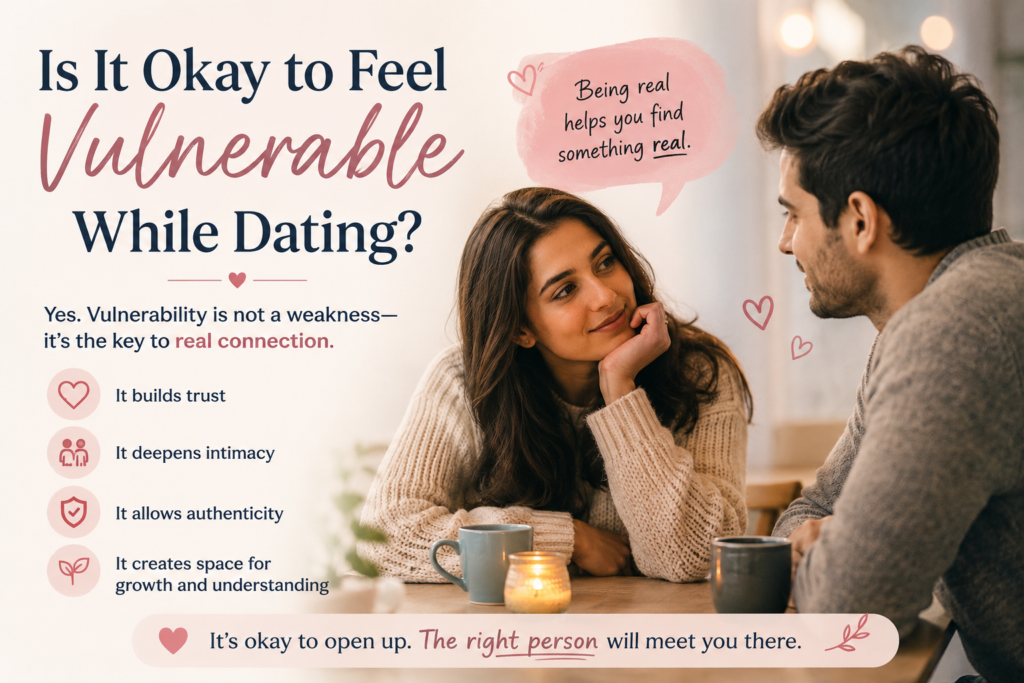
The honest answer is that vulnerability isn’t just okay in dating — it’s a necessary component of building any real, lasting connection. Understanding why can help shift vulnerability from something to be ashamed of into something to be worked with intentionally.
Vulnerability Is the Mechanism Through Which Real Connection Forms
Relationship research consistently identifies vulnerability — the willingness to be honest, to express real feelings, to risk being seen accurately rather than through a curated, guarded presentation — as one of the core mechanisms through which genuine intimacy develops. Without some degree of vulnerability, relationships tend to stay at a surface level, characterized by pleasant but ultimately shallow interaction, since deeper connection requires actually revealing who you are, uncertainties and imperfections included.
This means the discomfort of vulnerability isn’t an obstacle to good dating — it’s an unavoidable part of the process by which real, lasting connection actually gets built. Trying to date without any vulnerability isn’t a safer path to a good relationship; it’s a reliable way to prevent one from forming at all.
The Discomfort of Vulnerability Doesn’t Mean Something Is Wrong
It’s worth separating the discomfort of vulnerability from the idea that discomfort itself signals a problem. Vulnerability is inherently uncomfortable because it involves genuine risk — the risk of not being received well, of investing in something uncertain, of being honest about feelings that might not be reciprocated. That discomfort is a natural, expected part of the experience, not evidence that something is going wrong or that you should retreat into more guarded behavior.
Confusing the discomfort of vulnerability with a signal to stop being vulnerable is one of the more common ways people unintentionally sabotage promising connections — retreating into self-protection precisely at the moments that would otherwise allow real intimacy to develop.
Vulnerability Without Discernment Isn’t the Same as Healthy Vulnerability
It’s worth being clear that healthy vulnerability isn’t the same as indiscriminate openness with anyone, regardless of how they’ve demonstrated trustworthiness. Healthy vulnerability is generally reciprocal and paced appropriately — increasing gradually as trust is built through consistent, safe interaction, rather than being deployed all at once with someone who hasn’t yet earned that level of openness. Sharing deeply personal information on a first date, for example, isn’t necessarily “more vulnerable” in a healthy sense — it can sometimes reflect a different pattern, like difficulty regulating emotional pacing, rather than genuine relational courage.
The healthiest form of vulnerability tends to unfold gradually, calibrated to the actual trust that’s been established, rather than either being withheld entirely out of fear or overshared without regard to whether the relationship has actually earned that level of openness yet.
Feeling Vulnerable Is Often a Sign of Genuine Investment
As discussed in related contexts, vulnerability tends to increase alongside genuine investment — the more you care about an outcome, the more exposed you naturally feel to the possibility of disappointment. This means feeling vulnerable in a new dating situation is often simply a sign that the connection matters to you, rather than a sign of weakness or poor emotional boundaries. The absence of vulnerability, ironically, would more likely indicate a lack of genuine investment than a healthier emotional state.
Why Hiding Vulnerability Tends to Backfire
Attempting to hide or suppress vulnerability — presenting a falsely composed, unaffected version of yourself to avoid feeling exposed — tends to prevent exactly the kind of connection most people are actually looking for. Partners generally aren’t drawn to a flawless, guarded presentation; they’re drawn to genuine connection, which requires some visibility into who you actually are, including uncertainty, imperfection, and real feeling. A relationship built entirely on a guarded, curated presentation of yourself has a much harder time deepening into real intimacy later, since the foundation itself was never built on authentic vulnerability to begin with.
Vulnerability and Emotional Safety Work Together
Vulnerability functions best within a context of emotional safety — being met with respect and genuine engagement, even if the specific feeling shared isn’t reciprocated exactly. This is part of why vulnerability feels different, and generally safer, with partners who have already demonstrated some degree of emotional maturity and consistency, versus partners whose track record suggests dismissiveness or unreliability. It’s reasonable, and healthy, to calibrate how much vulnerability you extend based on how much emotional safety has actually been established, rather than extending the same level of openness indiscriminately regardless of context.
How to Practice Healthy Vulnerability in Dating
A few practical principles can help. Start with smaller, lower-stakes forms of vulnerability early on — expressing a genuine opinion, sharing a real (if minor) uncertainty — and observe how it’s received before escalating to deeper disclosures. Pay attention to reciprocity: healthy vulnerability tends to be met with some degree of vulnerability in return over time, rather than remaining entirely one-sided. And resist the urge to retreat into guardedness the moment vulnerability starts to feel uncomfortable — some discomfort is expected and doesn’t necessarily indicate a problem with the relationship.
The Takeaway
Feeling vulnerable while dating isn’t just okay — it’s a necessary, expected part of building any real connection, and its discomfort doesn’t indicate that something is wrong. What matters is practicing vulnerability with discernment: pacing it appropriately to the trust that’s actually been established, noticing whether it’s being met with reciprocity and respect, and resisting the instinct to retreat into guardedness simply because vulnerability feels uncomfortable. Real intimacy, by its nature, requires exactly the kind of exposure that vulnerability represents — there isn’t a safer, more protected path to genuine connection that skips it entirely.
Leave a Reply