

Your cart is currently empty!
How Emotional Connection Develops Over Time
Emotional connection is often talked about as though it either exists or doesn’t — you either “click” with someone or you don’t. In reality, emotional connection is less like a switch and more like a process, one that unfolds through a series of recognizable stages, each requiring something different to move forward. Understanding this process can help set realistic expectations for how connection actually builds, rather than expecting it to arrive fully formed from the start.
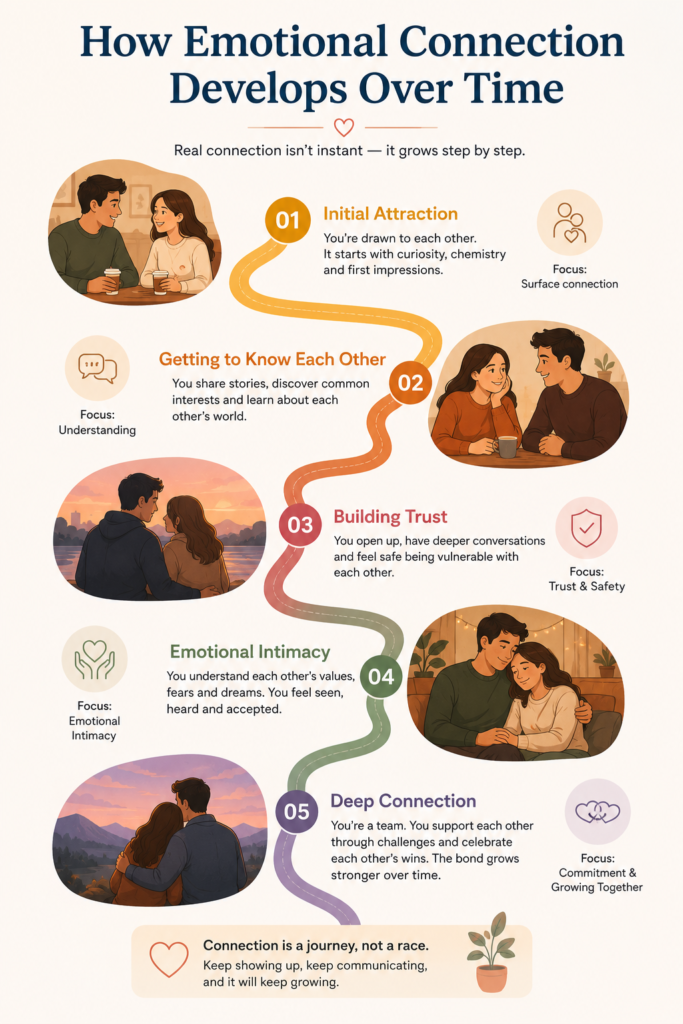
Stage One: Surface-Level Rapport
Early emotional connection typically begins with surface-level rapport — easy conversation, shared humor, basic compatibility that makes spending time together pleasant. This stage is important but limited; it establishes that two people can enjoy each other’s company, without yet requiring much vulnerability or real emotional risk from either person.
Many early dates stay at this level, and that’s normal — surface rapport is a reasonable foundation to build on, but it isn’t yet emotional connection in the deeper sense. Mistaking strong rapport for deep connection is a common early-dating misstep, since rapport can be present with many people, while deeper connection requires additional stages to actually develop.
Stage Two: Self-Disclosure
The next stage involves gradually increasing self-disclosure — sharing more personal information, opinions, and experiences beyond surface-level small talk. Psychological research on relationship development, including the well-known concept of “social penetration theory,” describes this as a process where increasing breadth and depth of self-disclosure is one of the primary mechanisms through which closeness develops.
This stage requires a degree of vulnerability from both people, and it typically develops gradually rather than all at once — sharing something moderately personal, observing how it’s received, and calibrating how much further to open up based on that response. Rushing this stage (oversharing too much, too soon) can sometimes create a false sense of intimacy that isn’t actually matched by genuine trust yet established.
Stage Three: Responsiveness and Feeling Understood
As self-disclosure increases, a critical factor determines whether it actually builds connection: how it’s received. Psychological research on relationship closeness points to “perceived partner responsiveness” — the sense that the other person genuinely understands, validates, and cares about what you’ve shared — as one of the strongest predictors of growing emotional intimacy. Simply exchanging information doesn’t build connection on its own; it’s the sense of being truly heard and understood that transforms disclosure into genuine closeness.
This is why connection can stall even when two people are sharing plenty of information about themselves — if that sharing isn’t met with real attentiveness and validation, it doesn’t accumulate into deeper intimacy the way responsive engagement does.
Stage Four: Consistency Across Contexts
Emotional connection deepens further as it’s tested and confirmed across a range of different contexts and circumstances — not just during pleasant dates, but during minor disagreements, stressful moments, logistical friction, or simply ordinary, unremarkable time together. This stage is where connection moves from something built primarily on curated, positive interactions into something grounded in a fuller, more accurate picture of who the other person actually is across varied conditions.
This is part of why emotional connection genuinely deepens with time — not simply because more time has passed, but because more varied contexts have provided more opportunities to confirm (or challenge) the connection built during the earlier, more curated stages.
Stage Five: Mutual Vulnerability and Trust
As consistency accumulates, deeper vulnerability becomes possible — sharing fears, insecurities, and needs that carry more emotional risk than earlier, lighter disclosures. This stage typically can’t be rushed, because it depends on a foundation of demonstrated trustworthiness built through the earlier stages. Attempting this level of vulnerability before that foundation exists often produces anxiety rather than closeness, since the emotional risk isn’t yet supported by enough accumulated evidence of safety.
Relationships that successfully reach and sustain this stage tend to be the ones capable of real, lasting intimacy — not because the people involved are inherently more compatible, but because they’ve allowed the connection to develop through the necessary stages rather than skipping ahead.
Why Skipping Stages Tends to Backfire
A common pattern in unstable or short-lived relationships is skipping stages — jumping quickly to intense vulnerability or declared deep connection without the intermediate stages of responsiveness, tested consistency, and gradually built trust. This can create a feeling of intense closeness early on, but that closeness often isn’t durable, because it wasn’t built on the accumulated evidence that makes deeper stages sustainable. When reality inevitably introduces friction or imperfection, connections built this way are more prone to sudden collapse, since they lacked the foundation that slower-developing connections have time to establish.
Connection Can Stall at Any Stage
It’s worth noting that emotional connection doesn’t automatically progress through these stages — it can stall at any point, for various reasons. A relationship might stay comfortably at surface rapport indefinitely if one or both people aren’t ready or willing to increase vulnerability. Self-disclosure might increase without being met by genuine responsiveness, preventing deeper trust from forming. Recognizing which stage a connection seems to be stuck at can help clarify what, specifically, might be missing, rather than experiencing the stall as a vague, unexplained sense that something isn’t working.
What This Framework Means for Early Dating
Understanding this staged process can help recalibrate expectations in early dating. It’s reasonable for a connection to feel like “just” surface rapport after a few dates — that’s not evidence of a lack of chemistry, it’s simply where the process naturally starts. It’s also reasonable to expect that real depth requires more time and more varied context than a handful of curated, pleasant interactions can provide. Patience with this process, rather than expecting deep connection to arrive fully formed early on, tends to produce more accurate assessments of a relationship’s real potential.
The Takeaway
Emotional connection develops through a recognizable process — from surface rapport, through increasing self-disclosure, responsiveness, tested consistency across varied contexts, and eventually mutual vulnerability and trust. Each stage builds on the one before it, and skipping ahead tends to create connection that feels intense but lacks a durable foundation. Understanding this framework can help set more realistic expectations for how real, lasting connection actually forms — gradually, through accumulated evidence, rather than instantly through a single good conversation or a strong initial impression.
Leave a Reply