

Your cart is currently empty!
What Dating Anxiety Is Trying to Communicate
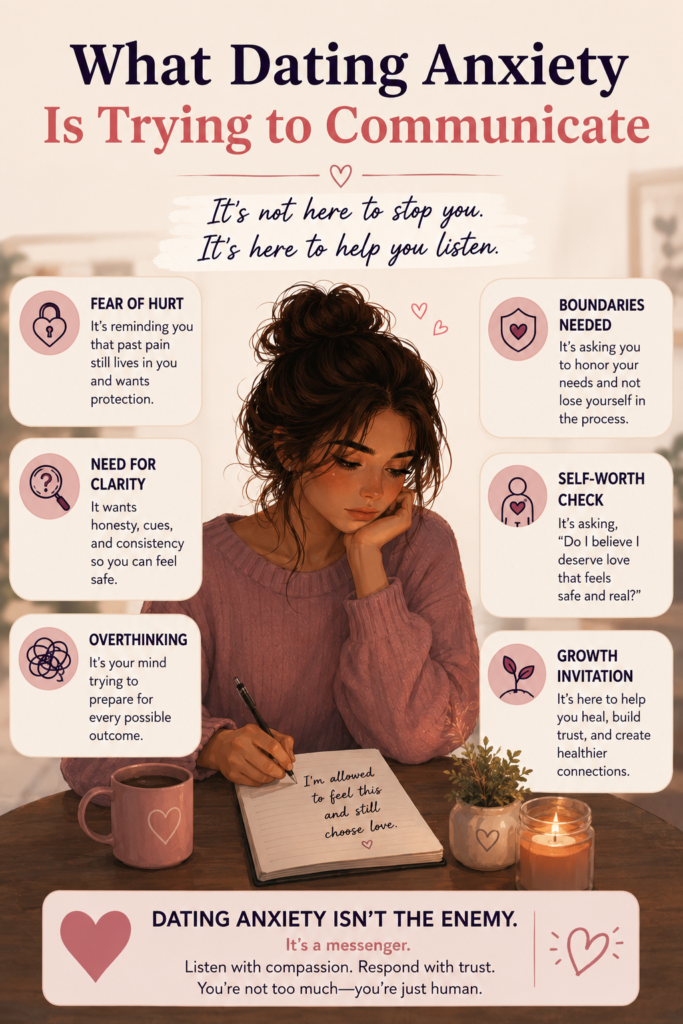
Dating anxiety is usually treated as a problem to eliminate — an unpleasant feeling to manage, suppress, or push through as quickly as possible. But anxiety, in most contexts, isn’t just noise; it’s a signal, carrying information that’s worth interpreting rather than simply dismissing. Learning to read what dating anxiety is actually trying to communicate, rather than just trying to make it go away, can turn a frustrating experience into a genuinely useful source of self-knowledge.
Anxiety Often Signals Investment, Not Danger
One of the most important reframes is recognizing that a significant portion of dating anxiety isn’t actually warning you about danger — it’s reflecting how much you care about an uncertain outcome. As covered elsewhere, anxiety and excitement share a physiological root, and the intensity of dating-related anxiety often tracks more closely with how much you like someone than with any actual evidence of risk.
When anxiety shows up this way, its message isn’t “something is wrong” — it’s closer to “this matters to me, and I don’t have certainty about the outcome yet.” Recognizing this distinction can prevent you from misreading investment-driven anxiety as an accurate warning sign about the relationship itself.
Sometimes Anxiety Is Flagging a Genuine Mismatch
Not all dating anxiety is simply about investment and uncertainty — sometimes it’s picking up on real, concerning information that hasn’t yet been consciously processed. A persistent, specific unease around a particular behavior — dismissiveness, inconsistency, a pattern of dishonesty — can be your intuition registering something worth paying attention to, even before you’ve fully articulated the concern in words.
The key distinction between this kind of anxiety and investment-driven anxiety is specificity. Anxiety tied to a concrete, nameable behavior or pattern deserves serious consideration. Diffuse, free-floating anxiety that isn’t attached to any specific concern is more often about vulnerability and uncertainty in general, rather than accurate information about a particular red flag.
Anxiety Can Signal Unmet Needs
Sometimes dating anxiety reflects a mismatch between what you need to feel secure and what a relationship is currently providing. If you consistently feel anxious in situations involving ambiguity or inconsistent communication, that anxiety might be highlighting a genuine need for more clarity or consistency than the relationship currently offers — information worth communicating directly, rather than simply tolerating in silence.
This reframes recurring anxiety not as a personal flaw to manage privately, but as potentially useful information about needs that could be addressed through direct communication with a partner, rather than something you have to individually white-knuckle through indefinitely.
Anxiety Can Reflect Past Experience Rather Than Present Reality
As discussed in the context of old wounds and fear of abandonment, dating anxiety is sometimes less about the current situation and more about patterns carried over from past relationships or earlier attachment experiences. In these cases, the anxiety’s “message” isn’t really about the present relationship at all — it’s an echo of unresolved past experience being triggered by present-day closeness or vulnerability.
Recognizing when anxiety fits this pattern — disproportionate to anything the current partner has actually done, and more connected to a recognizable past pattern — is important, because it changes what kind of response actually helps: not more information-gathering about the current relationship, but more direct attention to processing the underlying, older material.
Anxiety Can Signal a Need to Slow Down
Sometimes anxiety in dating isn’t about the other person or the relationship at all, but about pace — a sense that things are moving faster than you’re emotionally ready for, even if you’re genuinely interested in the person. This kind of anxiety often responds well to intentionally slowing down, rather than pushing through it in an effort to keep pace with the relationship’s momentum. Anxiety of this kind is less a warning about the relationship’s viability and more a signal about your own readiness and capacity in a given moment.
Distinguishing Between These Different Messages
Given the range of things dating anxiety can actually be communicating, it’s worth developing a habit of pausing to ask what kind of anxiety you’re experiencing, rather than reacting to all anxiety the same way. A few useful questions: Is this anxiety attached to something specific and observable, or is it diffuse and hard to pin down? Does it track with how much I care about the person, suggesting investment rather than danger? Does it feel familiar, like something I’ve experienced in past relationships regardless of who I was with? Does it seem connected to the pace of the relationship rather than to the person or their behavior specifically?
Answering these questions honestly can help direct your response appropriately — addressing a genuine concern directly, processing old material through reflection or therapy, adjusting the pace of a relationship, or simply tolerating investment-driven anxiety as a normal, expected part of caring about someone.
Why Trying to Eliminate All Anxiety Isn’t the Right Goal
Given how much useful information anxiety can carry, the goal of dating shouldn’t be to eliminate anxiety entirely — that would mean either suppressing genuinely useful signals or, more realistically, avoiding caring about outcomes enough to generate any anxiety in the first place, which isn’t actually a healthier alternative. A more useful goal is developing the ability to interpret anxiety accurately, responding to what it’s actually communicating rather than either dismissing it entirely or treating all anxious feeling as equally alarming and equally actionable.
What Actually Helps
Practically, this means building a habit of pausing when anxiety arises, rather than immediately reacting to it — either by suppressing it or by acting on it impulsively. Taking a moment to ask what specifically is driving the feeling, and whether it points toward a concrete concern, an old pattern, an unmet need, or simply the discomfort of genuine investment, allows for a more calibrated response than treating every anxious moment as an emergency requiring immediate resolution.
The Takeaway
Dating anxiety isn’t a single, uniform experience with one meaning — it can signal genuine investment in an uncertain outcome, a real concern worth taking seriously, an unmet need worth communicating, an old wound being triggered by present closeness, or simply a sense that the pace feels faster than you’re ready for. Learning to distinguish between these different messages, rather than treating all anxiety as equally alarming or equally dismissible, turns a frustrating experience into a genuinely useful source of information about yourself and your relationships.
Leave a Reply