

Your cart is currently empty!
Why Overthinking Texts Is Common
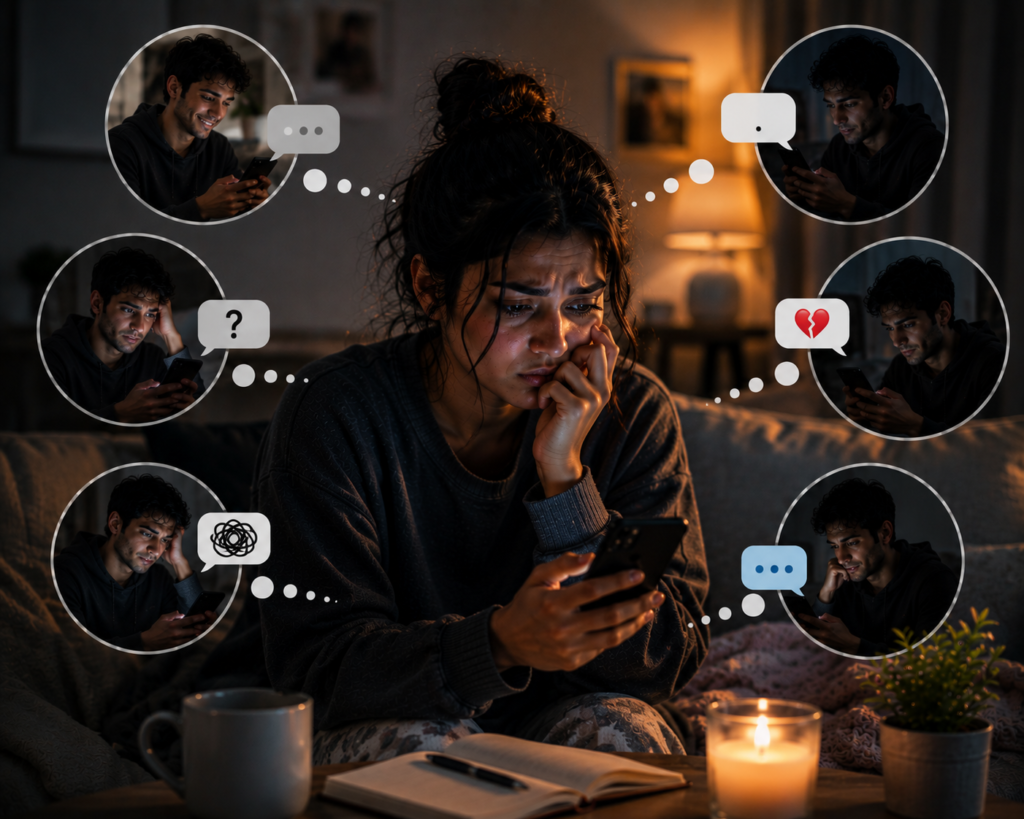
You read their message.
Then you read it again.
You notice they used a period instead of an emoji.
You wonder why they didn’t ask a question this time.
Then you start thinking about how long they took to reply.
Suddenly, one simple text has turned into a full investigation.
If this sounds familiar, you’re not alone.
Overthinking texts is common, especially when you care about someone and the relationship doesn’t have a clear definition. In a situationship, you may not know exactly how the other person feels, what they expect, or where the connection is going.
That uncertainty can make ordinary messages feel unusually important.
A short reply can feel like rejection.
A delayed response can feel like distance.
A heart emoji can feel like commitment.
And a long conversation can make you believe the relationship is finally moving forward.
But texting rarely provides enough information to answer all those questions.
Understanding why overthinking texts is common can help you step away from the constant analysis and focus on what actually matters: the overall relationship, consistent behavior, and honest communication.
Why Do People Overthink Text Messages?
Text messages contain very little context.
When you’re speaking to someone face-to-face, you can observe:
- Tone of voice.
- Facial expressions.
- Body language.
- Timing.
- Immediate reactions.
Texting removes most of those signals.
That leaves your brain with gaps.
And when you care about the person, your mind may try to fill those gaps with explanations.
Unfortunately, uncertainty can make negative interpretations feel especially convincing.
1. You Don’t Know Where You Stand
Situationships are often undefined.
You may not know:
- Whether you’re exclusive.
- How serious their feelings are.
- Whether they want commitment.
- Whether they’re seeing other people.
- What they expect from the connection.
When the relationship itself is uncertain, every message can start feeling like evidence.
You may think:
“They said they miss me, so maybe they want a relationship.”
Then:
“They didn’t text today, so maybe they changed their mind.”
You’re trying to understand the relationship through individual messages because you don’t have enough clarity about the relationship itself.
2. You Care About the Person
The more emotionally invested you become, the more important their communication can feel.
If a stranger takes six hours to respond, you probably won’t care.
If someone you deeply like takes six hours, you may notice immediately.
Their message isn’t just a message anymore.
It becomes connected to your feelings about:
- Attraction.
- Security.
- Reassurance.
- Rejection.
- Hope.
That emotional investment can make you pay attention to details you would normally ignore.
3. You’re Afraid of Losing the Connection
Overthinking often comes from fear.
You may worry:
“What if they’re losing interest?”
“What if someone else is more important?”
“What if I said something wrong?”
“What if this situationship ends?”
When you fear losing someone, your brain may start looking for warning signs.
Every change in communication can feel significant.
4. You Start Looking for Hidden Meaning
Texting makes it easy to analyze individual words.
For example:
“Sure.”
You might wonder:
“Why did they just say sure?”
“Okay!”
You may think:
“They sound happier.”
“Okay.”
“Are they annoyed?”
But sometimes “okay” simply means okay.
Not every message contains a hidden emotional message.
5. Response Time Can Become Emotionally Important
You may start remembering how quickly someone normally responds.
They usually reply in 20 minutes.
Today it’s been three hours.
Your mind immediately notices the difference.
You may begin wondering whether their feelings have changed.
But response time can change for countless reasons.
They may be:
- Working.
- Driving.
- Sleeping.
- With friends.
- Busy with family.
- Taking a break from their phone.
Response time alone isn’t a reliable measure of someone’s feelings.
6. You May Compare Their Current Messages With Old Ones
Another common habit is comparing conversations.
You might scroll through older messages and notice:
“They used to send longer replies.”
“They used to ask more questions.”
“They used to use more emojis.”
“They used to say good night every day.”
Sometimes communication naturally changes.
People don’t text with exactly the same energy every day.
A change in texting style becomes more meaningful when it’s part of a broader pattern of reduced effort or emotional distance.
7. Social Media Gives You More Information to Analyze
Texting anxiety can become much worse when social media enters the picture.
You see:
- They’re online.
- They posted a story.
- They liked a post.
- They were recently active.
But they haven’t replied.
Now you’re trying to understand not only the message but also their online behavior.
This can create a lot of unnecessary emotional noise.
Being online doesn’t necessarily mean someone is available for a meaningful conversation.
8. Past Experiences Can Influence Your Reactions
Sometimes you’re not only reacting to the current person.
You may also be reacting to previous experiences.
If you’ve experienced:
- Ghosting.
- Rejection.
- Hot-and-cold communication.
- Sudden breakups.
- Someone disappearing without explanation.
you may become more alert to changes in communication.
Your mind may be trying to prevent you from being hurt again.
Understanding this can help you respond to the present situation rather than automatically assuming the past is repeating itself.
9. Inconsistent Texting Can Make Overthinking Worse
Not all overthinking comes from within.
Sometimes the communication pattern itself is confusing.
For example:
Day 1: They text constantly.
Day 2: They send affectionate messages.
Day 3: They disappear.
Day 4: They return like nothing happened.
Repeated hot-and-cold communication can make anyone wonder what’s happening.
If inconsistency is a regular pattern, it may be worth discussing rather than simply telling yourself to “stop overthinking.”
10. You May Be Using Texts for Reassurance
Sometimes you aren’t really analyzing the message.
You’re looking for reassurance.
You want to know:
“Do they still like me?”
“Are we okay?”
“Am I important to them?”
When their message provides reassurance, you feel better.
When they don’t respond, anxiety returns.
This can create a cycle:
Uncertainty → checking → text → relief → uncertainty → checking again
Recognizing this cycle can help you understand why texting feels so emotionally powerful.
Signs You’re Overthinking Texts
You may be overanalyzing communication if you:
- Read messages multiple times.
- Analyze punctuation.
- Count how long someone takes to reply.
- Check their online status.
- Ask friends to interpret messages.
- Screenshot conversations for analysis.
- Rewrite your replies repeatedly.
- Worry about whether you sounded too interested.
- Feel anxious when they don’t respond.
- Compare today’s communication with older conversations.
Occasional curiosity is normal.
Constant analysis can become emotionally exhausting.
Is Overthinking Texts a Sign You Like Someone?
Sometimes.
When you care about someone, their communication naturally matters more.
But excessive overthinking can also indicate uncertainty.
You may not simply be attracted to them.
You may be unsure about:
- Their feelings.
- Their intentions.
- Your place in their life.
- The future of the connection.
In other words, you may be overthinking because you don’t have enough clarity.
How to Stop Overthinking Text Messages
1. Separate Facts From Stories
This is one of the most useful habits.
Fact:
“They haven’t replied for four hours.”
Story:
“They’re losing interest.”
You know the first thing.
You don’t necessarily know the second.
Keeping that distinction clear can prevent your thoughts from becoming assumptions.
2. Stop Reading Into Every Small Detail
Not every:
- Emoji.
- Period.
- “Okay.”
- Typing delay.
- Short response.
needs analysis.
Ask yourself:
“Would I interpret this message the same way if I wasn’t emotionally invested?”
That question can help put things into perspective.
3. Don’t Check Their Online Status
If checking their activity makes you anxious, stop checking.
You don’t need to know:
- When they were last online.
- Whether they viewed your story.
- Who they followed.
- Whether they’re active.
More information doesn’t always create more clarity.
Sometimes it simply creates more things to overthink.
4. Give Yourself a Break From the Conversation
After sending a message, return to your day.
You don’t need to keep the chat open.
Try:
- Putting your phone away.
- Starting work.
- Meeting a friend.
- Going for a walk.
- Watching a movie.
- Cooking.
- Reading.
The goal isn’t to pretend you don’t care.
It’s to remember that your life continues even while you’re waiting.
5. Don’t Use Texting as Your Relationship Compass
If you want to know whether someone is interested, don’t rely only on their messages.
Look at:
- Whether they make plans.
- Whether they follow through.
- Whether they make time for you.
- Whether they communicate honestly.
- Whether they respect your boundaries.
- Whether they include you in their life.
Actions provide context that texts often can’t.
6. Communicate Instead of Guessing
If you’re constantly wondering what someone wants, ask.
For example:
“I’ve really enjoyed getting closer to you, but sometimes I feel unsure about where we stand. I’d rather understand what we’re both looking for than keep guessing.”
A direct conversation may feel uncomfortable.
But it can provide more clarity than analyzing hundreds of messages.
7. Keep Your Own Life Full
Overthinking becomes easier when one person occupies too much of your emotional attention.
Continue investing in:
- Friends.
- Family.
- Career.
- Hobbies.
- Fitness.
- Personal goals.
- Time alone.
The healthier your life outside the situationship, the less power a single text has over your mood.
8. Look for Patterns Instead of Moments
One short text doesn’t define a relationship.
One delayed response doesn’t define someone’s feelings.
Instead, ask:
“What has their behavior consistently looked like over time?”
Are they generally:
- Reliable?
- Caring?
- Consistent?
- Curious about you?
- Emotionally open?
Or are they generally:
- Unavailable?
- Inconsistent?
- Avoidant?
- Unclear?
Patterns tell you more than isolated moments.
When Overthinking May Be Telling You Something
Sometimes anxiety isn’t simply something you need to eliminate.
It may be highlighting a genuine problem.
If you constantly feel uncertain because the other person:
- Disappears frequently.
- Gives mixed signals.
- Avoids commitment conversations.
- Changes their behavior repeatedly.
- Only contacts you when convenient.
then your discomfort may be responding to real inconsistency.
The answer isn’t always:
“I need to stop overthinking.”
Sometimes it’s:
“I need more clarity.”
What If You Can’t Stop Overthinking Their Texts?
If you’ve tried stepping back but still feel consumed by the uncertainty, consider what the relationship is giving you.
Ask:
“If the texting pattern stayed exactly the same for the next six months, would I be happy?”
If the answer is no, you may need to reconsider whether the situationship meets your emotional needs.
You don’t have to become less sensitive to stay in a relationship that consistently makes you uncomfortable.
FAQs
Why is overthinking texts so common?
Overthinking texts is common because written messages provide limited context. When you’re emotionally invested and uncertain about a relationship, your mind may try to interpret small details to understand what the other person feels.
Why do I analyze every text from my situationship?
You may be using their messages to look for reassurance or clues about where you stand. The uncertainty of a situationship can make ordinary communication feel unusually important.
Does overthinking texts mean I’m too needy?
Not necessarily. It may simply mean that you care about the person or feel uncertain about the relationship. However, if texting consistently controls your mood, it may be worth exploring what kind of clarity or security you need.
How do I stop overthinking someone’s messages?
Separate facts from assumptions, avoid monitoring online activity, stop rereading conversations, stay engaged in your own life, and focus on overall behavior rather than individual texts.
Should I ask my situationship what their texts mean?
Instead of asking what every individual message means, ask about the relationship itself. Understanding their intentions and expectations can provide much more useful clarity.
Can inconsistent texting cause overthinking?
Yes. Repeated hot-and-cold communication can create uncertainty and make you pay closer attention to changes in texting patterns. If the inconsistency is persistent, discussing it directly may be more helpful than continuing to analyze individual messages.
Final Thoughts
Understanding why overthinking texts is common starts with recognizing that you’re often not analyzing the message itself.
You’re trying to understand what the message says about the relationship.
When you don’t know where you stand, a delayed reply can feel like rejection. A short message can feel cold. A romantic message can create hope.
But one text rarely provides enough information to understand someone’s feelings.
Instead of asking:
“What does this message mean?”
try asking:
“What does their overall behavior tell me?”
That shift can help you move away from constantly decoding your phone and toward understanding the relationship itself.
You don’t need to stop caring.
You don’t need to pretend you’re unaffected.
You simply need to remember that your emotional security shouldn’t depend on interpreting every notification.
If the relationship is clear, consistent, and mutually invested, individual texts usually won’t feel like such a mystery.
And if you’re constantly trying to decode someone’s messages because you don’t know where you stand, the bigger issue may not be your tendency to overthink.
Leave a Reply