

Your cart is currently empty!
How Texting Patterns Reveal Emotional Availability
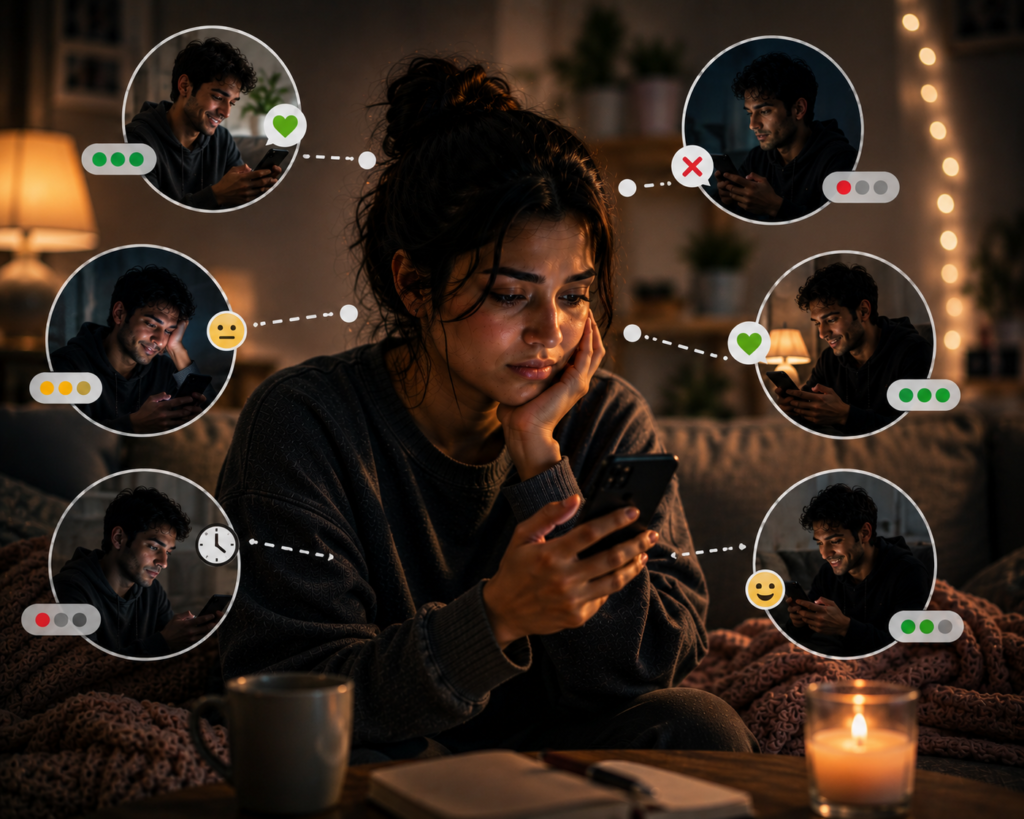
When you’re getting to know someone, texting can reveal more than just how often they use their phone.
It can sometimes give you clues about how comfortable they are with emotional closeness, communication, vulnerability, and consistency.
This becomes especially noticeable in a situationship.
You may text regularly but still feel unsure about where you stand. One day, the person may be warm and emotionally open. The next, they may become distant. They might talk about personal feelings but avoid conversations about the relationship.
You may then start wondering:
“Are they emotionally available?”
“Do they actually want to get closer?”
“Why do they open up one day and disappear the next?”
Understanding how texting patterns reveal emotional availability can help you recognize communication patterns without treating every message as a definitive sign of someone’s feelings.
Texting cannot tell you everything about a person’s emotional availability. People have different communication styles, schedules, and personalities.
However, when you look at patterns over time—and compare texting with real-life behavior—you can often learn a great deal about how someone approaches emotional connection.
What Does Emotional Availability Mean?
Emotional availability means being reasonably open and willing to engage with emotional closeness.
An emotionally available person may be able to:
- Communicate their feelings.
- Listen to your feelings.
- Discuss difficult topics.
- Show vulnerability.
- Maintain reasonable consistency.
- Respect emotional boundaries.
- Talk about relationship expectations.
- Take responsibility when communication goes wrong.
Being emotionally available doesn’t mean someone has to text constantly or share every thought.
It means they’re generally capable of creating emotional connection without repeatedly avoiding or sabotaging it.
Can Texting Really Reveal Emotional Availability?
Texting can provide clues, but it shouldn’t be treated as a psychological test.
A person who replies slowly isn’t automatically emotionally unavailable.
Someone who texts constantly isn’t automatically emotionally available.
Instead, pay attention to how they communicate, not simply how much they communicate.
Look for patterns such as:
- Consistency.
- Reciprocity.
- Emotional openness.
- Curiosity.
- Follow-through.
- Willingness to discuss uncomfortable subjects.
These patterns can be more informative than response times.
1. Consistent Communication Can Show Emotional Reliability
One of the clearest positive signs is consistency.
An emotionally available person doesn’t necessarily text every day. But when they communicate, there is usually some level of reliability.
They may:
- Reply when they can.
- Let you know when they’re busy.
- Continue conversations rather than constantly disappearing.
- Follow up on things you’ve discussed.
- Maintain communication even after vulnerable conversations.
Consistency creates predictability.
And predictability can make emotional closeness feel safer.
2. They Ask About Your Feelings, Not Just Your Day
There’s a difference between:
“How was work?”
and:
“You seemed stressed yesterday. Are you feeling better today?”
The second question shows emotional attention.
Someone who is emotionally available may remember how you felt previously and follow up later.
They aren’t simply collecting information about your day.
They’re paying attention to you.
3. They Can Have Conversations Beyond Flirting
Flirty texting can be fun, but emotional availability involves more than attraction.
Pay attention to whether someone can comfortably talk about:
- Fears.
- Goals.
- Family.
- Personal challenges.
- Values.
- Relationships.
- Emotional experiences.
If every conversation becomes sexual or playful whenever things start becoming serious, it may indicate discomfort with emotional depth.
4. They Don’t Disappear After Vulnerable Conversations
Imagine you share something deeply personal.
An emotionally available person may respond with care, curiosity, or reassurance.
An emotionally unavailable person might suddenly become distant whenever conversations become emotionally intimate.
One instance doesn’t prove anything.
But if the pattern repeatedly looks like:
Emotional closeness → Vulnerability → Withdrawal
it’s worth paying attention to.
5. They Don’t Avoid Every Difficult Conversation
Emotional availability doesn’t mean someone enjoys conflict.
Most people find difficult conversations uncomfortable.
The important question is whether they can eventually engage with them.
For example, if you ask:
“Are we looking for the same thing?”
an emotionally available person may not have the answer you want, but they can usually participate in the conversation.
Avoidance can look like:
- Changing the subject.
- Joking whenever things get serious.
- Ignoring the question.
- Becoming defensive.
- Disappearing.
- Saying “I don’t want to talk about this” every time.
One difficult conversation isn’t a problem.
Consistently avoiding emotional conversations can be.
6. They Communicate When Their Availability Changes
Life gets busy.
People have work, family responsibilities, travel, and personal commitments.
Someone being unavailable isn’t necessarily a problem.
What matters is how they communicate it.
For example:
“This week is hectic, so I may be slow to reply. I’ll call you this weekend.”
That gives you context.
You aren’t left wondering whether something has changed.
This kind of communication can demonstrate emotional consideration.
7. Their Texting Isn’t Only About Their Needs
Pay attention to what happens when they want something.
Do they only text when they’re:
- Lonely?
- Bored?
- Looking for attention?
- Interested in physical intimacy?
- Having a bad day?
Or do they also reach out to:
- Check on you.
- Celebrate your good news.
- Ask about your goals.
- Support you.
- Share things that remind them of you.
Mutuality is an important part of emotional availability.
8. They Remember Details
Emotional attention often appears in small ways.
They remember:
- An important meeting.
- Your favorite food.
- Something you were worried about.
- A family event.
- A goal you mentioned.
- A story from your childhood.
This doesn’t mean someone who forgets a detail is emotionally unavailable.
But consistent interest in your life can indicate genuine emotional engagement.
9. They Don’t Use Silence to Control the Connection
There is a difference between needing space and using silence as a way to control someone.
Healthy space might sound like:
“I need some time to clear my head. I’ll talk to you tomorrow.”
Unhealthy communication may involve repeatedly disappearing to create anxiety and then returning when they want attention.
The pattern matters.
If silence becomes a recurring way of creating uncertainty, it can be emotionally exhausting.
10. They Can Say What They Want
One of the strongest signs of emotional availability is the ability to communicate intentions.
They may not know exactly what the future holds.
That’s okay.
They can still say:
“I’m interested in getting to know you seriously.”
Or:
“I’m not looking for a committed relationship right now.”
Clarity doesn’t require certainty about the future.
It requires honesty about the present.
11. They Can Admit When Something Went Wrong
Emotional availability also involves accountability.
If there was a misunderstanding, can they say:
“I handled that badly.”
or:
“I understand why that hurt you.”
Someone doesn’t have to agree with every feeling you have.
But being able to acknowledge another person’s perspective is important.
12. They Match Their Words With Their Actions
This may be the most important sign of all.
Someone may text:
“I really care about you.”
But what happens outside the phone?
Do they:
- Make time for you?
- Keep plans?
- Respect your boundaries?
- Show up consistently?
- Make an effort to build the connection?
Emotional availability isn’t just something someone says.
It’s something you can observe through repeated behavior.
Texting Patterns That May Suggest Emotional Distance
Again, none of these behaviors automatically prove emotional unavailability.
But repeated patterns can be worth noticing.
Frequent disappearing
They regularly vanish whenever the connection becomes closer or more serious.
Avoiding emotional conversations
They keep things superficial or change the subject when you discuss feelings.
Hot-and-cold communication
They become intensely affectionate and then suddenly distant.
Only contacting you when convenient
Communication centers around their schedule and needs.
Avoiding relationship questions
They enjoy emotional intimacy but refuse to discuss what the relationship means.
Minimal curiosity
They talk extensively about themselves but rarely ask about you.
Affection without accountability
They send romantic messages but don’t take responsibility for behavior that hurts you.
What About Someone Who Is a Slow Texter?
Slow texting isn’t the same as emotional unavailability.
Someone can be:
- Busy.
- Introverted.
- Less attached to their phone.
- More comfortable with calls.
- Naturally independent.
The more useful question is:
“Are they emotionally responsive when communication actually happens?”
Someone who takes five hours to respond but sends a thoughtful message and follows through may be more emotionally available than someone who replies instantly but avoids every meaningful conversation.
What About Someone Who Texts All Day?
Frequent texting isn’t proof of emotional availability either.
Someone can text constantly because they:
- Enjoy attention.
- Like flirting.
- Are lonely.
- Prefer digital communication.
- Want something casual.
Look at what happens when the relationship requires emotional responsibility.
Can they discuss expectations?
Can they handle vulnerability?
Can they communicate through discomfort?
Can they follow through?
That’s where emotional availability becomes clearer.
The Hot-and-Cold Pattern
One of the most confusing texting patterns in situationships is hot-and-cold communication.
It may look like:
Monday: Long emotional conversation.
Tuesday: Constant flirting.
Wednesday: “I miss you.”
Thursday: Almost no communication.
Friday: They return as if nothing happened.
This pattern can make you feel like you’re constantly trying to figure out which version of the person is real.
Occasional fluctuations are normal.
Repeated hot-and-cold behavior can create emotional uncertainty.
Why Emotional Unavailability Can Feel So Addictive
Unpredictable communication can make you focus more intensely on the person.
When attention is inconsistent, you may spend more time wondering when it will return.
You remember the moments when they were affectionate.
You wait for them to become that version of themselves again.
This can create a cycle of:
Distance → anticipation → reconnection → relief → distance
The emotional intensity can feel like chemistry, but intensity and compatibility aren’t always the same thing.
How to Read Texting Patterns Without Overthinking
Look at Patterns, Not Individual Messages
One short reply means very little.
Months of consistent behavior mean much more.
Compare Words With Actions
If someone says they want closeness but consistently avoids it, notice the mismatch.
Consider Their Personality
Not everyone communicates the same way.
Look at Real-Life Behavior
Texting is only one part of the relationship.
Ask Direct Questions
If you’re confused, communication will usually give you more information than analysis.
Questions to Ask Yourself
If you’re trying to understand someone’s emotional availability, ask:
Do I feel comfortable expressing my feelings?
Do they respond when conversations become vulnerable?
Can we discuss difficult subjects?
Do they show curiosity about my emotional world?
Is communication reasonably consistent?
Do their actions match their words?
Do I feel secure more often than confused?
Can they tell me what they want?
Your answers can reveal more than their response time ever will.
What If You Realize They’re Emotionally Unavailable?
First, don’t assume you can change them.
You can communicate your needs.
You can establish boundaries.
You can give someone an opportunity to meet you emotionally.
But you cannot make someone become emotionally ready.
If someone repeatedly shows that they cannot offer the type of emotional connection you need, you may have to decide whether staying is healthy for you.
How to Communicate Your Needs
You don’t have to accuse someone of being emotionally unavailable.
Instead, describe your experience.
For example:
“I’ve noticed that we communicate really closely sometimes, but when conversations become more emotional, you tend to pull away. I’m looking for a connection where we can communicate openly, so I wanted to understand how you feel about that.”
This creates room for an honest response.
FAQs
How can texting reveal emotional availability?
Texting can provide clues through patterns of consistency, emotional openness, curiosity, responsiveness, and willingness to discuss difficult subjects. However, texting alone cannot determine someone’s emotional availability.
Does slow texting mean someone is emotionally unavailable?
No. Response speed isn’t a reliable measure by itself. Someone can text slowly and still be emotionally present, reliable, and open.
What texting pattern suggests emotional unavailability?
Repeated disappearing, avoiding emotional conversations, hot-and-cold communication, and refusing to discuss relationship expectations may suggest emotional distance when these behaviors form a consistent pattern.
Can an emotionally unavailable person still have feelings?
Yes. Someone can have genuine feelings and still struggle with emotional intimacy, vulnerability, or commitment. Feelings don’t necessarily mean someone is capable of offering the type of relationship you need.
How do I know if someone is emotionally available in a situationship?
Look at their overall behavior. Emotional availability often involves consistent communication, openness, accountability, curiosity about your feelings, and willingness to discuss what the relationship means.
Should I stop texting someone who seems emotionally unavailable?
Not necessarily immediately. You can communicate your needs and observe whether the person is willing and able to meet them. If the pattern continues and the connection consistently hurts you, stepping back may be worth considering.
Final Thoughts
Understanding how texting patterns reveal emotional availability isn’t about analyzing every message, emoji, or response time.
It’s about looking for patterns.
Does the person communicate consistently?
Can they handle vulnerability?
Do they ask about your feelings?
Can they discuss difficult topics?
Do their words match their actions?
Are they willing to be honest about what they want?
Those questions tell you much more than whether someone replies within ten minutes or three hours.
An emotionally available person doesn’t have to be a perfect texter. They can be busy, independent, or naturally less attached to their phone.
What matters is whether they can create a connection where communication feels honest, respectful, and reasonably consistent.
And if you’re constantly trying to decode someone’s messages because their behavior keeps changing, consider looking beyond the screen.
Sometimes the clearest answer isn’t hidden in the text.
Leave a Reply