

Your cart is currently empty!
Is It Normal to Feel Anxious After a Good First Date?
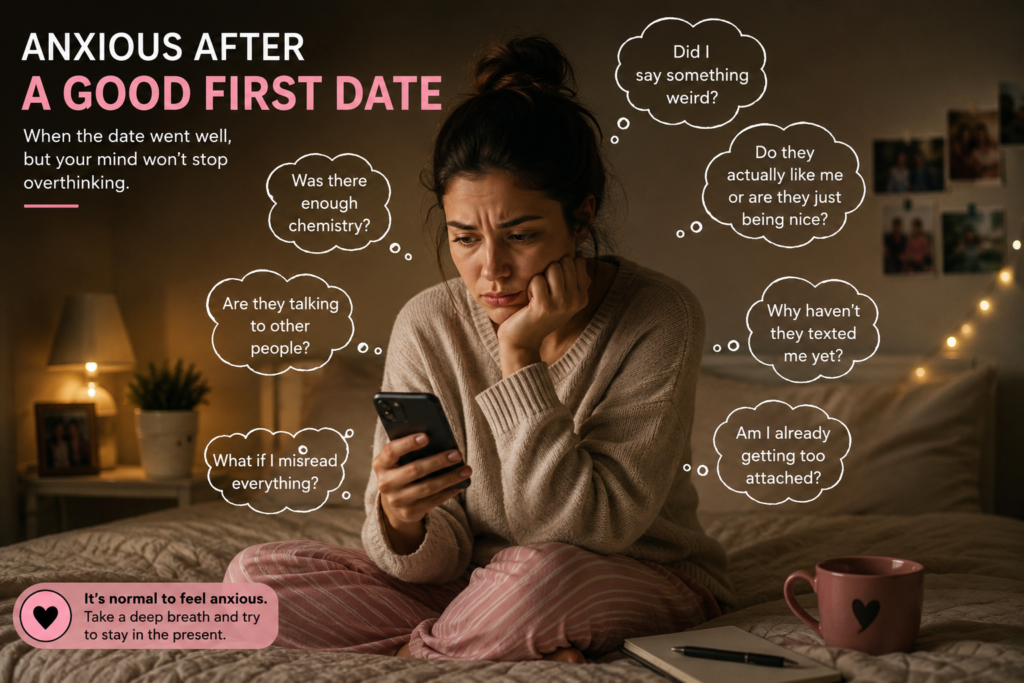
You’d expect a good first date to leave you feeling light — maybe a little giddy, hopeful, excited to see this person again. Instead, plenty of people find themselves feeling something closer to unease once they get home: replaying the conversation, worrying they said something wrong, wondering if the other person actually enjoyed it as much as it seemed, or feeling a strange dip in mood despite the date genuinely going well.
If this sounds familiar, you’re not alone, and it doesn’t mean the date wasn’t actually good. This reaction is far more common than most people realize, and it has clear psychological explanations.
Yes, This Is Genuinely Common
Post-date anxiety after a positive experience shows up frequently enough that it’s a recognized pattern among therapists who work with dating-related anxiety. It’s often more pronounced after good dates than bad ones, which seems counterintuitive until you understand what’s actually driving it.
A bad date rarely produces much anxiety afterward, because there’s nothing at stake — you already know it’s not going anywhere, so there’s nothing left to lose or hope for. A good date is different. It introduces the possibility of something you want, which immediately activates the fear of losing it. Anxiety, in this context, isn’t a sign that something is wrong with the date; it’s a sign that something felt worth caring about.
The Vulnerability of Wanting Something
Wanting an outcome — a second date, continued interest, the possibility of a relationship — introduces vulnerability that indifference doesn’t. Before the date, you had nothing specific to lose. After a good date, you suddenly have something you’d be disappointed to lose, and that shift alone is often enough to trigger anxiety, independent of any actual evidence that something is wrong.
This is why post-date anxiety often correlates with how much you liked the person, not with how the date actually went. A genuinely great connection can produce more anxiety afterward than a mediocre one, precisely because there’s more at stake emotionally.
The Brain’s Negativity Bias Kicks In After the Fact
During the date itself, you’re often in a more present, engaged state, focused on the conversation and the connection happening in real time. Once the date ends and you’re alone with your thoughts, a different cognitive mode tends to activate — one more prone to scanning for potential problems, replaying details, and searching for anything that might have gone wrong.
This shift is partly explained by a well-documented cognitive tendency called negativity bias: the brain’s tendency to weigh potential negative information more heavily than positive information, especially when reflecting after the fact rather than experiencing something in real time. This is why you might walk away from a date feeling genuinely good, only to find your mind circling back to one slightly awkward pause, magnifying it far beyond its actual significance.
Anxious Attachment Patterns Can Intensify This Response
For people with more anxious attachment tendencies, post-date anxiety after a good date can be especially pronounced. Anxious attachment is often characterized by heightened sensitivity to the possibility of rejection or abandonment, which can be activated precisely when a connection starts to feel promising — the emotional stakes rise, and with them, the fear of losing something that’s just beginning to feel possible.
This doesn’t mean everyone who feels this way has an anxious attachment style, but it’s a useful lens if this pattern shows up consistently and feels disproportionate to the actual situation. Recognizing the pattern as attachment-related, rather than as accurate information about the date itself, can help put the anxiety in better context.
The Uncertainty Gap Is the Real Trigger
A good first date creates a specific kind of uncertainty: you now have real interest, but no confirmed information about whether it’s mutual, or what happens next. That gap — genuine investment paired with genuine unknowns — is fertile ground for anxiety, regardless of how the date objectively went.
This is different from anxiety caused by actual red flags or concerning behavior. It’s anxiety generated by the simple structural fact that you now care about an outcome you don’t yet have control over or clarity on. That distinction matters, because it changes what the anxiety is actually telling you — not necessarily “something is wrong,” but “something now matters, and I don’t have certainty about it yet.”
How to Tell the Difference Between Normal Post-Date Anxiety and a Real Concern
It’s worth learning to distinguish between anxiety that’s simply about uncertainty, and anxiety that’s actually flagging something concerning about the date itself. A useful question: if you set aside the anxious feeling and just recall the concrete facts of the date — what was said, how you were treated, how the conversation flowed — do those facts, on their own, point to anything troubling? If the honest answer is no, the anxiety is likely more about vulnerability and uncertainty than about the date itself.
If, on the other hand, specific behaviors genuinely gave you pause — something dismissive, inconsistent, or uncomfortable — that’s worth taking seriously as real information, separate from the general anxiety of having liked someone. Anxiety tied to a specific, nameable concern deserves attention. Anxiety that’s diffuse and unattached to any concrete red flag is more often the product of investment and uncertainty than an accurate signal about the person.
Why This Anxiety Tends to Fade With Repetition
For most people, this kind of post-date anxiety tends to lessen with more information over time. As a second and third date happen, and a clearer, more consistent picture of the other person’s interest starts to form, the uncertainty gap narrows, and with it, the anxiety usually softens. This is part of why post-first-date anxiety often feels more intense than anxiety after later dates in the same connection — the information gap is at its widest right at the beginning.
What Actually Helps in the Moment
A few things can help take the edge off post-date anxiety without needing to eliminate it entirely. Reminding yourself, explicitly, that anxiety after a good date is common and doesn’t indicate a problem with the date itself can reduce the tendency to spiral into overanalysis. Resisting the urge to immediately seek reassurance — from the person themselves or by rereading old texts for reassurance — tends to help the anxiety settle on its own faster than compulsively checking for evidence one way or the other.
It also helps to give the situation a reasonable amount of time before drawing conclusions. One good date doesn’t require you to have full certainty about where things are headed; it’s normal, and healthy, to let more information accumulate before deciding how much weight to give any single interaction, anxious or otherwise.
The Takeaway
Feeling anxious after a good first date is a well-documented, common experience — not evidence that something went wrong, and not a sign that you’re bad at dating. It’s usually a byproduct of newly activated vulnerability, negativity bias kicking in during quiet reflection, and the natural discomfort of caring about an outcome you don’t yet have clarity on. As long as the anxiety isn’t tied to a specific, concrete concern about the date itself, it’s generally safe to treat it as a normal emotional response to genuine investment — one that tends to ease as more information, and more dates, naturally accumulate.
Leave a Reply