

Your cart is currently empty!
What Silence After a Date Usually Means
Few things in dating create as much anxious speculation as silence. A date goes well, you part ways with a warm goodbye, and then… nothing. No text that evening, no follow-up the next day. The silence itself starts to feel loud — like it must be communicating something, even though, technically, nothing has actually been said.
The truth is that silence after a date is one of the most ambiguous signals in dating, precisely because it can mean so many genuinely different things, most of which have nothing to do with how the date actually went.
Silence Is Not a Message, Even Though It Feels Like One
The core issue with interpreting silence is that it’s an absence of information, not a piece of information itself — but our brains are wired to fill gaps with meaning, especially gaps that feel emotionally significant. In the absence of an actual explanation, the mind tends to generate one, and it usually leans toward the explanation that confirms whatever anxiety was already present.
This is worth naming clearly: silence, on its own, does not confirm disinterest. It confirms only that you haven’t received a message yet. Everything else is inference, and inference built on zero actual information tends to be wrong more often than people expect.
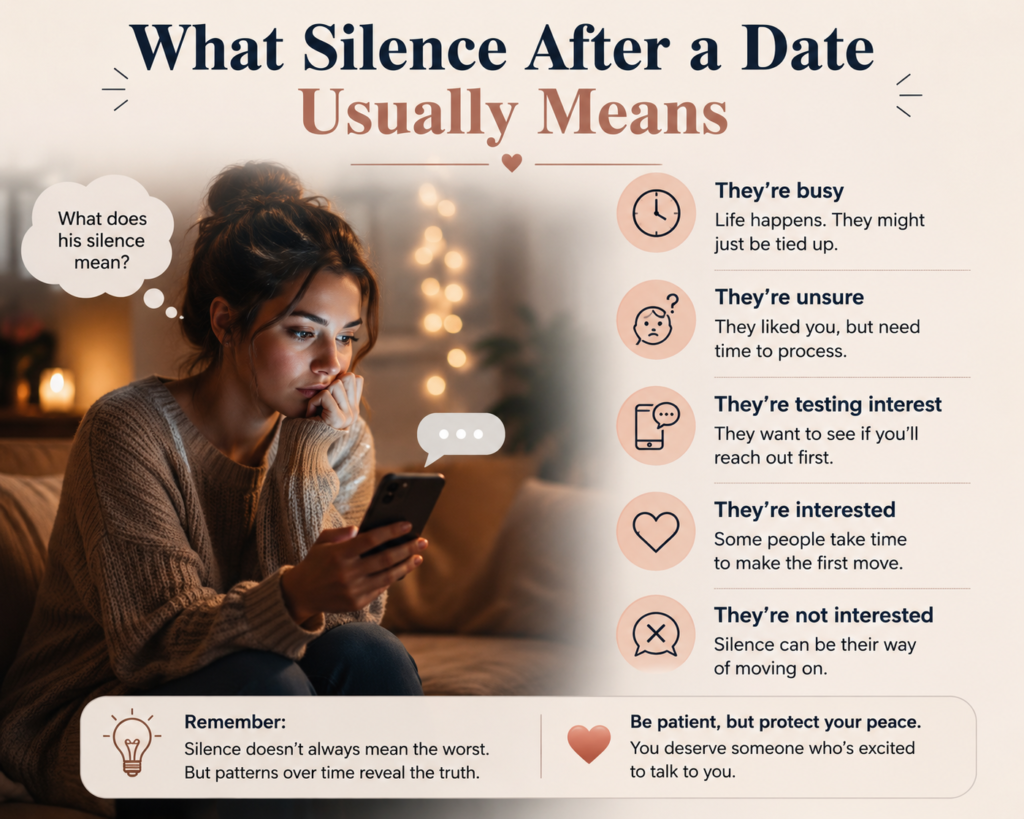
The Most Common (and Least Personal) Explanations
The overwhelming majority of silence after a date has nothing to do with how interested the person is. Life genuinely gets in the way more often than dating anxiety accounts for — work demands, family obligations, poor sleep, low energy, or simply not having gotten around to responding yet. None of these explanations are exciting or validating to consider, which is part of why the mind tends to skip past them in favor of more emotionally charged interpretations.
It’s also worth remembering that different people have genuinely different communication rhythms. Someone who takes a day or two to text after a date isn’t necessarily signaling disinterest — for many people, that pace is simply their normal baseline, unrelated to how the date went.
Silence Sometimes Reflects the Other Person’s Own Processing
Just as you might replay the date or feel post-date anxiety, the other person may be doing the same thing on their end. Some people need time after a date to sort out their own feelings before reaching out — not because they’re playing games or being intentionally distant, but because they’re processing the interaction at their own pace, the same way you might be.
This is especially common for people who are naturally more introverted or who tend to need space to reflect before engaging further, even in situations they’re genuinely excited about.
When Silence Does Reflect Genuine Disinterest
It would be inaccurate to say silence never means disinterest — sometimes it does. If silence persists for several days with no explanation, especially following a pattern of otherwise engaged, warm communication beforehand, it’s reasonable to consider that interest may have genuinely cooled, even if the specific reason isn’t clear to you.
The distinguishing factor isn’t the silence itself, but the pattern it fits into. A day or two of silence after a good date is well within normal range for a wide variety of non-personal reasons. A week or more of complete silence, especially without any previous indication of a busy or unpredictable communication style, starts to become more informative — not proof of disinterest, but a reasonable basis for adjusting your expectations.
Why Silence Feels Worse the More You Liked the Date
As with post-date anxiety and replaying conversations, the intensity of distress caused by silence tends to track directly with how much you liked the person and how well you believed the date went. A date you weren’t very invested in rarely produces much anxiety around subsequent silence, because there’s little at stake either way.
This means that unusually intense reactions to a short silence — spiraling after just a few hours of no response — are often more a reflection of how much hope was invested in the date than an accurate read of the situation itself. Recognizing this can help separate the emotional intensity of the reaction from the actual likelihood of a negative outcome.
The Trap of Overanalyzing Timing
A common but unreliable habit is treating the exact timing of a response as meaningful data — assuming a reply within two hours signals strong interest, while a reply after six hours signals fading interest. In reality, response timing is influenced by an enormous number of unrelated factors: what someone’s day looks like, whether they’re at work, how they personally use their phone, whether they’re the type to reply immediately to everyone or only check messages periodically.
Treating response timing as a precise measurement of interest gives it far more predictive weight than it actually deserves. It’s simply too noisy a signal to reliably decode, no matter how consistent the pattern might seem across a small number of data points.
What To Do Instead of Speculating
Rather than trying to decode silence through analysis, the more productive approach is simply allowing a reasonable amount of time to pass — a few days is generally reasonable for most connections — before deciding what it means. If you’re genuinely interested and haven’t heard anything after that window, a low-pressure, simple follow-up message (“Had a great time — would love to see you again if you’re up for it”) is usually far more useful than continued waiting and interpretation. It gives the other person an easy opening to respond and gives you real information, rather than more speculation.
If that message goes unanswered as well, that combination — initial silence followed by no response to a clear, warm follow-up — is a much stronger and more reliable signal than the initial silence ever was on its own.
Protecting Your Peace While You Wait
Regardless of what the silence eventually turns out to mean, the waiting period itself doesn’t have to be spent in anxious limbo. It helps to consciously limit how much mental space you give to a single unanswered message — setting a rough time frame for when you’ll check in again, and deliberately redirecting your attention to other parts of your life in the meantime, rather than treating your phone as something to monitor continuously.
It’s also worth remembering that your own worth and the quality of the connection you experienced during the date aren’t retroactively erased by a period of silence, regardless of what it eventually turns out to mean. A good date was still a good date, even if the outcome afterward doesn’t go the way you hoped.
The Takeaway
Silence after a date is one of the most commonly over-interpreted signals in dating, largely because it’s genuinely ambiguous and our minds are uncomfortable leaving ambiguity unresolved. Most silence has mundane, non-personal explanations, and even when it does eventually reflect fading interest, that’s usually only clear after a longer pattern — not from the first few hours or even the first day of no response. A reasonable amount of patience, followed by a direct and low-pressure follow-up if needed, will almost always tell you more than any amount of silent analysis ever could.
Leave a Reply