

Your cart is currently empty!
Is It Normal to Miss Someone After Two Dates?
Missing someone you’ve only been on two dates with can feel a little embarrassing to admit — it seems premature, maybe even irrational, given how little time you’ve actually spent together. You might find yourself downplaying it to friends, or quietly wondering if you’re moving too fast emotionally for someone you barely know.
The reassuring answer is that this experience is genuinely common and has clear psychological explanations. It doesn’t necessarily mean you’re moving too fast or setting yourself up for disappointment — though it’s worth understanding what’s actually happening so you can hold the feeling with the right amount of perspective.
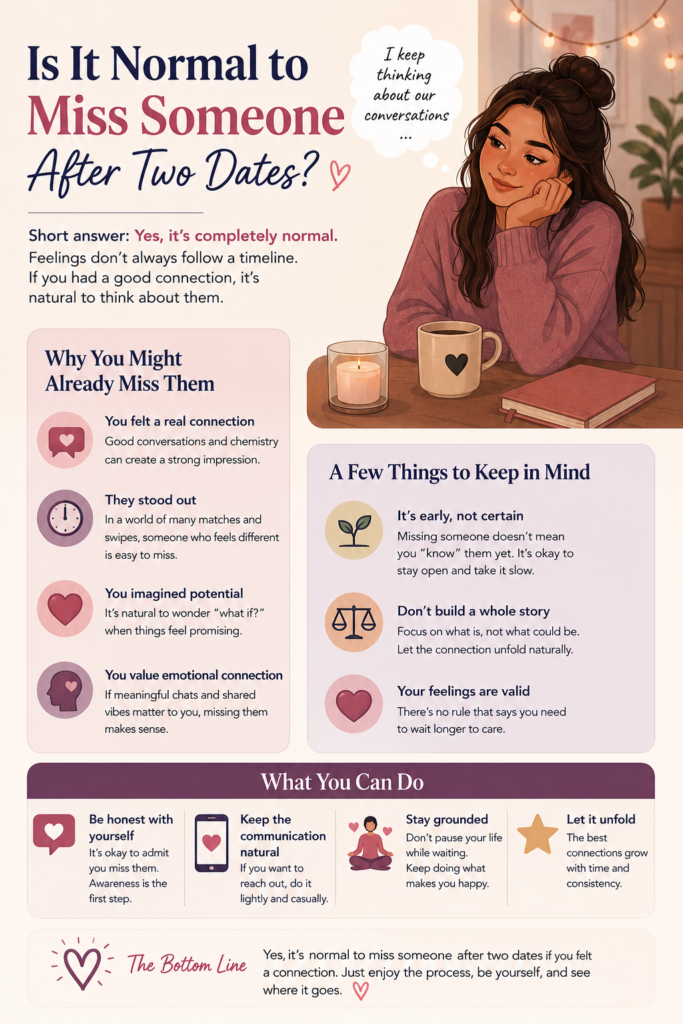
Missing Someone Isn’t About Time Spent — It’s About Emotional Salience
The intensity of missing someone is driven less by the total number of hours spent together and more by how emotionally significant those hours felt. Two dates that involved genuine connection, meaningful conversation, and real emotional presence can generate a stronger sense of missing someone than months of low-engagement interaction with someone else. Emotional salience — how vivid and significant an experience felt — tends to matter more to memory and longing than sheer duration.
This is why missing someone after two genuinely good dates isn’t irrational; it’s a reasonably accurate reflection of how emotionally significant those specific interactions were, even if the total time involved was objectively short.
The Brain Forms Attachment Cues Quickly
Human brains are wired to begin forming attachment-related responses fairly early in a positive interaction, particularly when it involves genuine emotional or physical closeness. Neurochemically, positive social bonding experiences — engaging conversation, physical affection, feeling understood — can activate reward and bonding-related brain chemistry relatively quickly, well before a relationship has reached any formal milestone like exclusivity or an extended dating history.
This means the sense of missing someone after a short amount of time isn’t purely psychological or “in your head” — it reflects real, measurable neurochemical processes that don’t wait for an arbitrary number of dates before activating.
Missing Someone Can Be Amplified by Anticipation
Part of what makes missing someone after only two dates feel intense is the uncertainty involved — you don’t yet know if you’ll see them again, whether the interest is mutual, or how the connection will develop. That uncertainty can actually amplify the feeling of missing someone, since anticipation and unresolved desire tend to occupy more mental space than settled, certain situations do. This is related to the same psychological principle (the Zeigarnik effect) that explains why unresolved situations get replayed and revisited more than resolved ones.
In other words, part of what you’re experiencing may not be pure longing for the person specifically, but a combination of genuine fondness and the natural mental pull of an unresolved, uncertain situation.
Is This a Sign You’re Moving Too Fast?
Missing someone after two dates doesn’t inherently mean you’re moving too fast emotionally — the feeling itself is just information about how meaningful the interactions felt, not necessarily a judgment about pacing. What matters more is what you do with the feeling. Acting on it in a way that pressures the relationship to move faster than the other person is ready for, or making major decisions based on a still-limited amount of information, would be moving too fast. Simply noticing and acknowledging the feeling, while still allowing the relationship to develop at a reasonable, evidence-based pace, isn’t a problem — it’s just honest self-awareness.
When This Feeling Might Warrant a Closer Look
It’s worth reflecting a bit more if the feeling of missing someone consistently occurs very early and intensely across multiple different dating situations, seemingly regardless of how the specific person actually treated you. If this is a recurring pattern — intense longing that develops almost immediately with nearly everyone you date, independent of actual compatibility or good treatment — it may be worth exploring whether this reflects a broader attachment pattern (sometimes associated with anxious attachment styles) rather than an accurate response to this specific connection.
This distinction matters because it changes what the feeling is actually telling you: is it specific, accurate information about a genuinely promising connection, or a more general pattern of quickly attaching regardless of the actual relationship’s substance?
How to Hold the Feeling Without Overreacting to It
If you notice yourself missing someone after just two dates, a balanced approach is to let the feeling exist without immediately acting on it in a way that outpaces the actual relationship. This might mean resisting the urge to text excessively or push for faster commitment, while still allowing yourself to feel genuinely excited about the connection. The feeling doesn’t need to be suppressed, but it also doesn’t need to dictate immediate, high-stakes decisions before more information has had a chance to accumulate.
It also helps to keep engaging with the rest of your life — friends, work, hobbies — so the feeling of missing someone doesn’t take up disproportionate space simply because there’s little else currently competing for your attention regarding this new connection.
What This Feeling Can Tell You (When Balanced With Evidence)
Missing someone after a short amount of time isn’t meaningless — it’s often a genuine signal that the interactions felt emotionally significant to you, which is worth taking seriously as one data point among several. Paired with other positive signals — consistent communication, mutual effort, genuine curiosity from the other person — it can be a reasonable, even encouraging, part of the overall picture. On its own, without other supporting evidence, it’s better treated as information about your emotional experience than as a definitive verdict on the relationship’s future.
The Takeaway
Missing someone after only two dates is a common, psychologically explainable experience — driven by emotional salience rather than time spent, amplified by natural uncertainty, and reflective of real neurochemical bonding processes that don’t wait for an arbitrary number of dates to activate. It doesn’t mean you’re moving too fast or being irrational. What matters is how you hold the feeling: as genuine, valid information about how meaningful the connection felt, without letting it single-handedly dictate decisions before more evidence has had time to accumulate.
Leave a Reply