

Your cart is currently empty!
Is Slow Texting a Bad Sign in Dating?
Few habits generate as much anxious analysis in early dating as response time. A reply that comes an hour later than expected can trigger a full mental review: did I say something wrong, are they losing interest, is this a sign I should pull back too. Slow texting has become one of the most commonly cited “red flags” in casual dating conversation — but how accurate is that reputation, really?
The honest answer is more nuanced than either “it’s always a bad sign” or “it never means anything.” Response speed carries some real information, but far less than most people assume, and understanding the difference can save a lot of unnecessary anxiety.
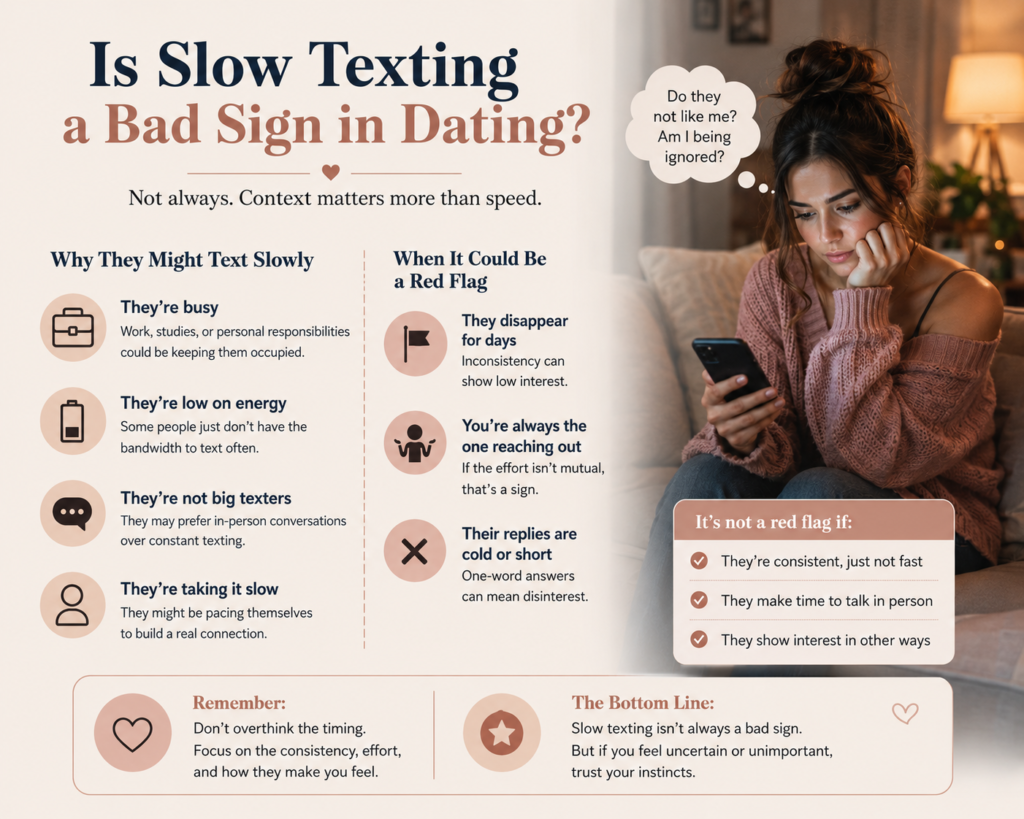
Why Slow Texting Gets Over-Interpreted
Response time is one of the few concrete, measurable data points available in early digital dating. Unlike tone, body language, or in-person chemistry, it’s a number — hours, minutes — which makes it feel more objective and analyzable than it actually is. This apparent precision is part of why it gets so much attention: it feels like real evidence, even when the underlying explanation for a slow reply could be almost anything.
The problem is that response time is influenced by dozens of factors that have nothing to do with interest — work schedules, phone habits, social battery, other commitments — and very few of those factors are visible to the person waiting for a reply. The number itself doesn’t carry the context needed to interpret it accurately, but our minds tend to fill in that missing context with the explanation we’re most afraid of.
Communication Styles Vary More Than People Account For
Some people are naturally quick, constant texters who reply within minutes regardless of who they’re talking to. Others are slower by nature — checking messages a few times a day, replying thoughtfully rather than immediately, or simply having a different baseline relationship with their phone. Neither style is inherently better, and neither reliably predicts more or less genuine interest.
This means a slow texter isn’t necessarily displaying disinterest — they may simply be displaying their normal communication pace, the same pace they’d use with anyone, regardless of how much they like them. Judging their interest level against a fast-texter’s baseline is comparing two different scales as if they were the same one.
The More Useful Signal Is the Pattern, Not the Speed
Rather than fixating on how long a single reply took, it’s far more informative to look at the overall pattern of communication over time. Does this person consistently follow through on plans? Do they engage meaningfully when they do respond, rather than replying with minimal effort? Is their communication style relatively steady, even if slow, rather than swinging unpredictably between enthusiastic and absent?
A consistently slow texter who always eventually replies with warmth and genuine engagement is showing a very different pattern than someone whose response time varies wildly and whose replies, when they come, feel distracted or minimal. The first pattern usually reflects a communication style; the second more often reflects fluctuating interest.
When Slow Texting Might Actually Mean Something
It would be inaccurate to say response time never carries information. If someone’s texting pace noticeably slows down after previously being consistent and engaged, that shift — not the raw speed itself, but the change — is worth paying attention to. A meaningful drop from frequent, warm texting to sparse, short, or delayed replies can genuinely reflect cooling interest, especially if it coincides with other signs of pulling back, like declining plans or shorter conversations overall.
The key distinction is between someone’s baseline pace (which tells you little) and a noticeable change from their own established pattern (which tells you more). The second is a far more reliable signal than the first.
Texting Anxiety Often Says More About You Than Them
It’s worth being honest that a lot of anxiety around slow texting isn’t really about the other person’s behavior — it’s about your own uncertainty and need for reassurance. This is especially common for people who lean toward anxious attachment patterns, where any gap in communication can trigger disproportionate worry, regardless of how the relationship is actually going.
Recognizing this doesn’t mean the anxiety isn’t real or valid — it clearly feels real in the moment. But separating “I feel anxious because I don’t have certainty” from “this person’s behavior is actually concerning” can help you respond to the anxiety itself, rather than assuming it’s always an accurate read of the situation.
Why Fast Texting Isn’t Automatically a Better Sign Either
It’s worth noting that quick, constant texting isn’t automatically a stronger signal of genuine interest than slower texting. Some people who text quickly and intensely early on do so out of habit rather than deep investment, and that intensity can fade just as quickly once the initial novelty wears off. Fast response time reflects communication style and availability as much as, or more than, it reflects depth of interest.
This is why response speed alone — in either direction — is a weaker predictor of relationship potential than people tend to assume. What happens over weeks, in terms of consistency and depth of engagement, tells you far more than how quickly any single message got answered.
How to Handle Slow Texting Without Spiraling
If you’re dating someone whose texting pace feels slower than you’re used to, a few approaches can help. First, give it enough time to establish whether the pace is a consistent baseline or an actual decline — a few weeks of observation is more informative than a single slow reply. Second, if the uncertainty is genuinely bothering you, it’s usually more productive to communicate that directly (“I tend to text pretty often — just curious what your usual pace looks like”) than to silently monitor and interpret.
It also helps to evaluate the relationship based on the full picture — quality of conversation, follow-through on plans, consistency of effort — rather than letting response time carry disproportionate weight simply because it’s the easiest thing to measure.
When to Take Slow Texting as a Genuine Concern
If slow texting is combined with other inconsistent behaviors — canceling plans, vague answers about the relationship’s direction, minimal effort during the conversations that do happen — it’s reasonable to weigh it as part of a broader pattern worth addressing. The concern in that case isn’t really about texting speed on its own; it’s about an overall pattern of inconsistency that texting speed happens to be one visible symptom of.
The Takeaway
Slow texting, on its own, is a weak and frequently misread signal in dating. It’s influenced by far more variables — personality, schedule, phone habits — than it is by genuine interest level, and treating it as a reliable measure of how someone feels about you will produce more anxiety than accurate insight. What matters more is the overall pattern: consistency, quality of engagement, and whether a person’s communication style shifts noticeably from their own established baseline. Judged that way, slow texting usually turns out to be far less meaningful than the anxious mind tends to assume.
Leave a Reply