

Your cart is currently empty!
Why Dating Brings Out Insecurity
There’s a specific kind of surprise that comes with noticing insecurities surface during dating that don’t seem to show up anywhere else in your life. You might feel generally settled and self-assured — until a new dating connection starts, and suddenly you’re comparing yourself to someone’s ex, worrying about a perceived flaw, or feeling unusually sensitive to small signs of disinterest.
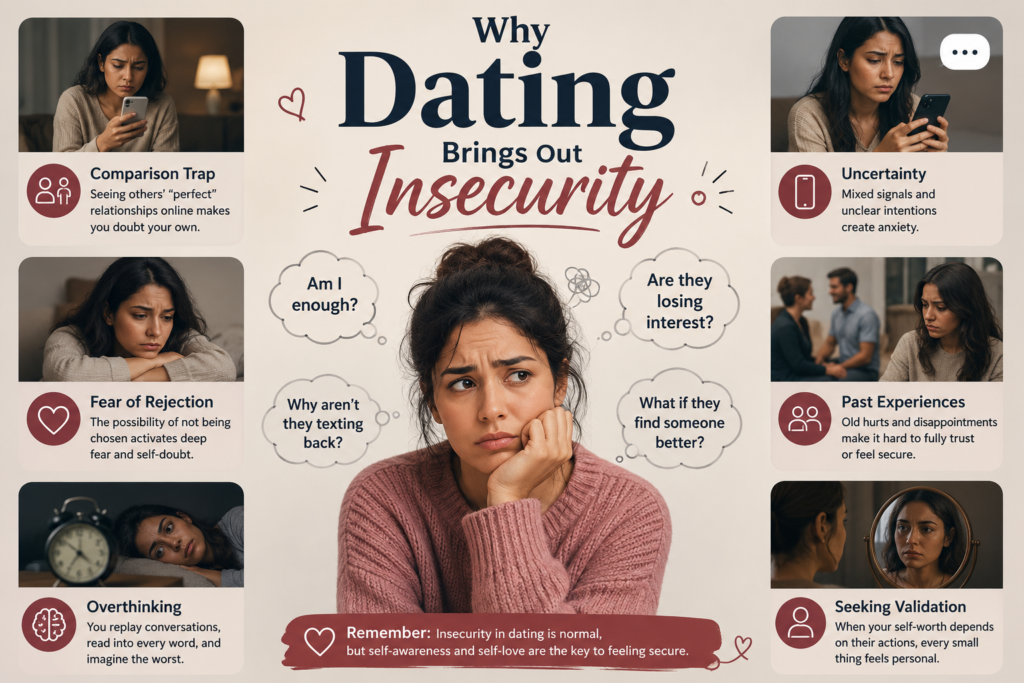
This isn’t a coincidence, and it doesn’t mean you’re secretly more insecure than you thought. Dating activates specific psychological conditions that make insecurity more likely to surface, even in people who function confidently in nearly every other area of life.
Dating Involves Being Evaluated in a Uniquely Personal Way
Most areas of adult life involve some form of evaluation — job performance reviews, social approval, athletic competition — but dating asks to be evaluated on something unusually personal: your desirability as a partner, which touches appearance, personality, and lovability all at once. That combination is more exposing than most other forms of evaluation, because it’s harder to separate the outcome from a judgment of your core self.
This is part of why rejection in dating can feel disproportionately painful compared to rejection in other areas — it isn’t just “this didn’t work out,” it can feel like “I wasn’t enough,” even when the actual reasons for a mismatch have little to do with your worth as a person.
Comparison Becomes Almost Unavoidable
Dating, especially in the app era, naturally invites comparison — to other matches, to a partner’s exes, to an idealized version of what a “good” partner looks like. Even without consciously seeking it out, this comparison creates fertile ground for insecurity to surface, particularly around traits that feel less within your control, like appearance, income, or specific personality traits a partner has mentioned valuing in the past.
This comparison is amplified by social media, where curated depictions of other people’s relationships and partners create an unrealistic reference point that can make ordinary insecurities feel more urgent or significant than they actually are.
Attachment Patterns Get Activated by Romantic Closeness
Insecurities often have roots in early relationship experiences — with caregivers, with past romantic partners — and dating is one of the few contexts in adult life that closely mirrors those early emotional dynamics: closeness, vulnerability, the possibility of being let down by someone who matters. This is why dating can activate old emotional patterns more intensely than friendships or professional relationships typically do.
People with more anxious attachment tendencies, for example, often find that dating brings out a heightened fear of not being enough or of being abandoned — patterns that may stay mostly dormant in other relationships but come alive specifically in the context of romantic vulnerability.
Wanting Something Increases Emotional Exposure
As with anxiety and overthinking, insecurity in dating tends to scale with how much you want the outcome. Low-stakes situations — dates you’re not particularly invested in — rarely surface much insecurity, because there’s little emotional exposure involved. The moment real interest and hope enter the picture, so does vulnerability, and insecurity often rides in alongside it.
This means that surfacing insecurity during dating isn’t necessarily a sign that something is deeply wrong with your self-esteem — it can simply be a sign that you’re allowing yourself to want something, which inherently increases how exposed you feel to disappointment.
Uncertainty Provides an Opening for Insecure Thoughts
Dating is full of ambiguous, unresolved moments — waiting for a reply, not knowing if someone else is also being considered, unclear signals about interest level. In the absence of clear, confirmed information, the mind tends to fill gaps with whatever narrative is most emotionally available, and for many people, insecurity is one of the most readily available narratives.
This is why the same uncertain situation — a slow reply, a quiet date — can trigger insecurity in one person and barely register for another. The uncertainty itself is neutral; what fills the gap depends heavily on each person’s existing emotional patterns and history.
Insecurity Isn’t Always About the Current Relationship
It’s worth distinguishing between insecurity genuinely triggered by something concerning in the current dynamic, and insecurity that’s being carried over from past experiences and simply activated by the vulnerability dating requires. If a specific person’s behavior — dismissiveness, inconsistency, comparison to others — is actively fueling the insecurity, that’s useful, relevant information about the current relationship.
If the insecurity feels disproportionate to anything the current person has actually done, and instead seems to be a familiar internal pattern showing up again, it’s more likely rooted in past experience than in this specific situation. Both are worth taking seriously, but they call for different responses — addressing the current relationship’s dynamics in one case, and doing more personal reflection or healing work in the other.
How Insecurity Can Distort Perception
One of the more concerning effects of dating-related insecurity is how it can distort how you interpret a partner’s actual behavior. Someone feeling insecure may read neutral behavior as rejection, interpret a partner’s normal independence as a sign of waning interest, or feel threatened by interactions that don’t actually pose any real threat. This distortion isn’t a character flaw — it’s a predictable effect of heightened emotional sensitivity — but it’s worth being aware of, because it can create friction or conflict based on a misread situation rather than anything the partner actually did.
What Actually Helps
Reducing dating-related insecurity rarely comes from trying to suppress the feeling directly. It comes more reliably from a combination of approaches: separating a specific rejection or setback from a broader statement about your worth; noticing when insecure thoughts are based on actual evidence versus assumption; and building enough of a stable, fulfilling life outside of dating that any single connection doesn’t carry the full weight of your self-esteem.
It also helps to notice when insecurity is a recurring pattern across multiple relationships, rather than something specific to one situation. A repeating pattern is often worth addressing more directly — through therapy or deliberate self-reflection — since it’s less likely to resolve simply by finding “the right person,” and more likely to require some direct attention to the underlying pattern itself.
The Takeaway
Dating brings out insecurity for identifiable, common reasons: it involves uniquely personal evaluation, invites comparison, activates old attachment patterns, and introduces vulnerability that low-stakes situations don’t require. Feeling insecure during dating doesn’t mean you’re broken or overly sensitive — it means you’re engaging with something that inherently exposes you more than most other parts of life. Recognizing that can make the feeling easier to manage, and easier to separate from an accurate read of your actual worth or your actual compatibility with the person you’re dating.
Leave a Reply