

Your cart is currently empty!
Why Dating Brings Up Old Wounds
It’s a strange and often unwelcome surprise: you meet someone new, someone who has done nothing wrong, and yet you find yourself reacting with an intensity that seems to belong to a different relationship entirely — old fears of abandonment, old patterns of insecurity, emotional reactions that feel disproportionate to anything actually happening in the present. It can feel confusing, even embarrassing, especially if you thought you had already worked through whatever pain those reactions are connected to.
This experience is extremely common, and it has a clear psychological explanation rooted in how emotional memory and attachment actually work.
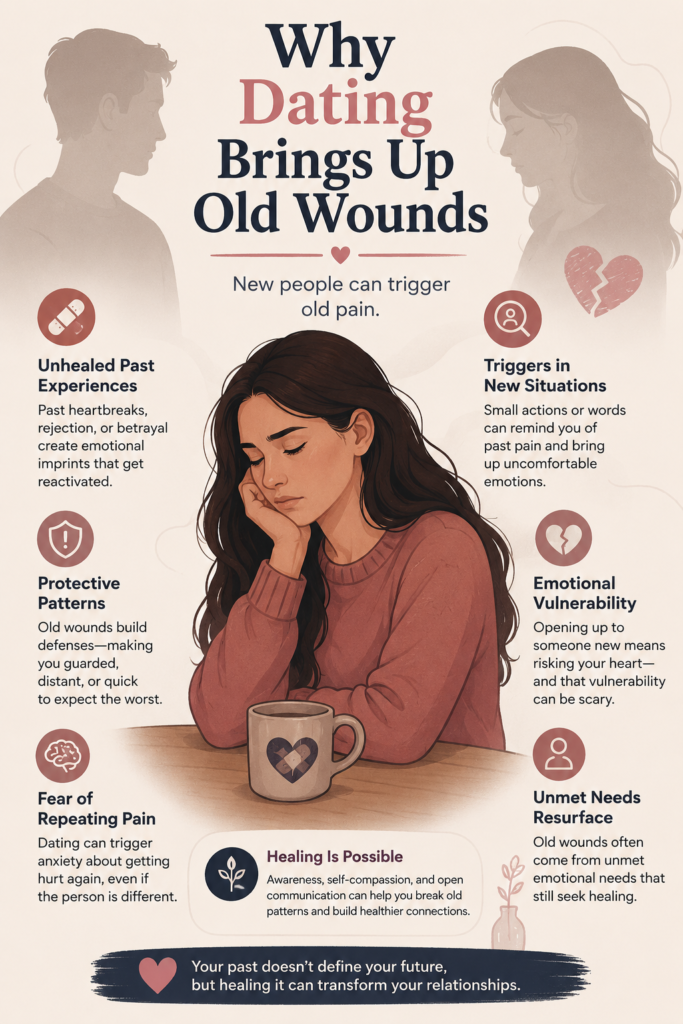
Romantic Closeness Is a Uniquely Powerful Trigger for Old Patterns
Of all the relationships in adult life, romantic ones most closely resemble the emotional dynamics of early attachment — closeness, vulnerability, dependency, the possibility of being let down by someone who matters deeply. Because of this resemblance, dating and romantic relationships are uniquely capable of activating emotional patterns and memories connected to earlier attachment experiences, whether those experiences were with caregivers or with past romantic partners.
This is why old wounds tend to surface specifically in romantic contexts, even when they stay mostly dormant in friendships, work relationships, or other parts of adult life that don’t require the same kind of vulnerability.
Emotional Memory Doesn’t Require Conscious Recall
A key feature of how emotional memory works is that it doesn’t require you to consciously remember a specific past event in order to be activated by it. The body and nervous system can respond to a present situation that resembles a past painful one — a specific tone of voice, a pattern of inconsistency, a feeling of being unimportant — even if you’re not consciously thinking about the original experience that created the association in the first place.
This is why old wounds can surface as a strong emotional reaction without an obvious, conscious trigger — the reaction is being generated by an implicit, body-level memory system that operates largely below conscious awareness, rather than a deliberate act of recalling the past.
New Relationships Create the Same Conditions That Once Caused Pain
Ironically, the very features that make a new relationship feel promising — vulnerability, emotional openness, genuine investment — are the same conditions under which past hurt was originally experienced. This overlap means a new, genuinely different, healthier relationship can still trigger old patterns, simply because the emotional conditions (closeness, vulnerability, dependency) resemble the conditions under which the original wound was formed, even though the actual person and circumstances are completely different.
This is an important distinction, because it means old wounds surfacing in a new relationship don’t necessarily indicate that the new relationship is repeating the old pattern — sometimes it simply means the new relationship has created enough genuine closeness to activate old material that needed closeness as a trigger in the first place.
Unresolved Pain Doesn’t Disappear on Its Own
A common misconception is that time alone resolves emotional pain from past relationships or experiences. In reality, unprocessed pain tends to remain present, even if less consciously active, until it’s actually addressed in some way — through reflection, therapy, or other intentional processing. Dating, by creating the emotional conditions similar to where the original pain occurred, often surfaces this unprocessed material specifically because it hasn’t actually been resolved, regardless of how much time has passed since the original experience.
This reframes old wounds surfacing in dating not as a sign of weakness or failure to “get over” the past, but as an indication that some emotional work remains, work that dating has simply brought back into view rather than created from nothing.
Old Wounds Can Distort Present-Day Perception
One of the more challenging effects of old wounds surfacing in dating is how they can distort perception of a current, genuinely different partner. Past experiences of betrayal, for example, can make someone hypervigilant to signs of dishonesty in a new relationship, even when no actual dishonesty is present. Past experiences of emotional neglect can make ordinary independence from a new partner feel like a repeat of past neglect, even though the two situations aren’t actually comparable.
Recognizing this distortion is important, because it allows for a more accurate separation between reactions that are proportionate to what’s actually happening now, and reactions that are being amplified by unresolved material from a different relationship entirely.
This Doesn’t Mean the New Relationship Is Wrong
It’s worth stating clearly: old wounds surfacing doesn’t mean the new relationship is a bad match, or that you’re destined to repeat past patterns. It means the new relationship has created enough real emotional closeness to bring old material to the surface — which is, in a strange way, often a sign of a relationship that matters, rather than evidence that something is fundamentally broken.
The key task isn’t avoiding relationships that trigger old wounds (which would mean avoiding meaningful closeness altogether), but learning to recognize when a reaction is being amplified by old material, and responding to the present situation based on its actual evidence, rather than the intensity of the emotional reaction alone.
How to Work With This Pattern Constructively
A few approaches genuinely help. Building enough self-awareness to notice when a reaction feels disproportionate to the current situation — and pausing to consider whether it might be connected to past experience rather than present reality — can prevent old wounds from unfairly shaping how you treat a new, potentially very different partner.
It also helps to communicate honestly with a partner when you recognize this happening — “I’m noticing I’m reacting strongly to this, and I think it might be connected to something from my past rather than about you specifically” — which allows a partner to respond with understanding rather than confusion about a reaction that seems disconnected from their actual behavior.
For patterns that show up repeatedly and significantly affect your relationships, therapy is often the most effective way to directly process the underlying wounds, rather than continuing to manage their effects indirectly every time a new relationship activates them.
The Takeaway
Dating brings up old wounds because romantic closeness closely resembles the emotional conditions under which those wounds were originally formed, activating implicit emotional memory that doesn’t require conscious recall to influence present-day reactions. This is a common, well-explained pattern — not a sign that something is wrong with you or with the new relationship. Learning to recognize when a reaction is amplified by past experience, rather than fully proportionate to the present situation, is one of the more valuable skills for dating in a way that’s fair to both yourself and to a partner who deserves to be responded to based on who they actually are.
Leave a Reply