

Your cart is currently empty!
Why Dating Triggers Fear of Abandonment
Fear of abandonment can show up in dating in ways that feel disproportionate to the actual situation — intense anxiety over a slightly delayed text, a strong emotional reaction to a partner spending time with friends, a persistent, hard-to-shake worry that someone is going to leave, even when there’s no real evidence pointing in that direction. For people who experience this, it can be confusing and even distressing, particularly when the relationship itself seems to be going reasonably well.
Understanding where this fear typically comes from, and why dating specifically tends to activate it, can make it easier to manage rather than be overwhelmed by.
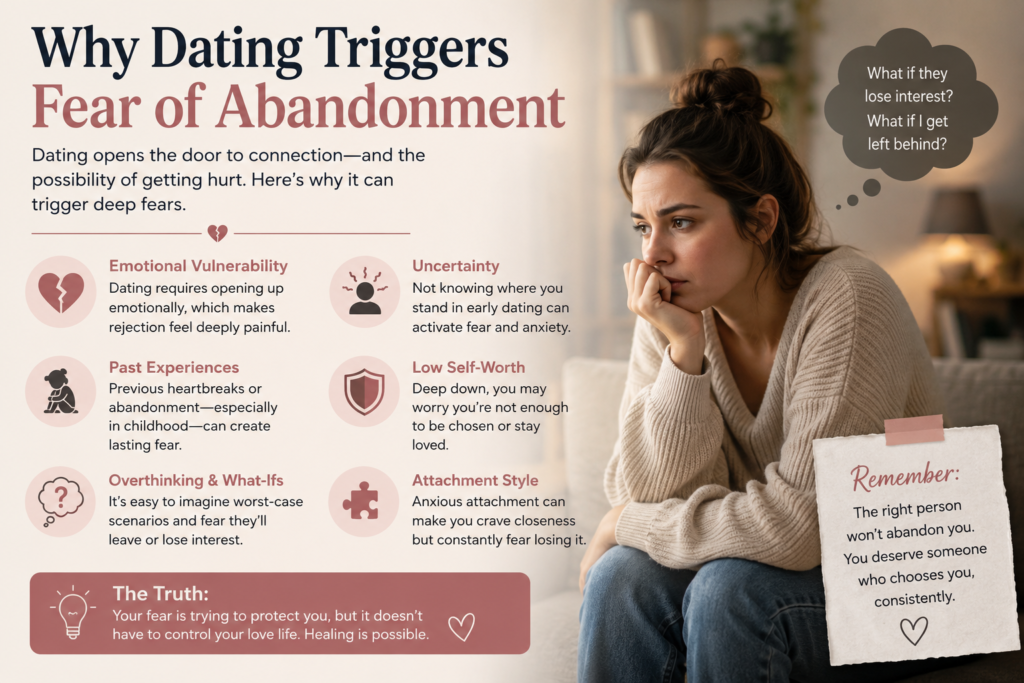
Fear of Abandonment Usually Has Roots in Earlier Experience
Fear of abandonment often traces back to earlier relational experiences — inconsistent or unavailable caregiving in childhood, a significant loss, or a past romantic relationship that ended in a way that felt sudden, unexplained, or deeply painful. These experiences can create a lasting template in which closeness becomes associated with the risk of eventual loss, a template that gets activated specifically in situations that resemble the emotional conditions of the original experience — which romantic relationships, more than most other adult relationships, closely resemble.
This means fear of abandonment isn’t usually really about the current partner specifically — it’s a pattern being triggered by present-day closeness that happens to resemble the conditions under which the original fear was formed.
Why Romantic Relationships Specifically Activate This Fear
Of all adult relationships, romantic ones involve a distinct combination of emotional dependency, exclusivity, and vulnerability that closely parallels early attachment relationships. This is part of why fear of abandonment, even when it stays dormant in friendships or professional relationships, tends to surface specifically in the context of romantic closeness — the emotional structure of the relationship itself resembles the conditions under which the original fear developed, more than other adult relationships typically do.
Ambiguity Provides Fertile Ground for This Fear
As discussed in relation to overthinking and mixed signals, ambiguous situations tend to get filled with whatever narrative is most emotionally available — and for someone with underlying fear of abandonment, that narrative often defaults toward an expectation of eventual loss. An unanswered text, a slightly distant mood, a partner’s need for independent time — all of these can, in the absence of clear information, be interpreted through the lens of impending abandonment, even when far more benign explanations are equally or more plausible.
This tendency isn’t a conscious choice; it reflects the way fear of abandonment shapes how ambiguous information gets processed, often below the level of full conscious awareness.
The Fear Can Create Behaviors That Strain the Relationship
One of the more difficult aspects of fear of abandonment is that it can generate behaviors — excessive reassurance-seeking, difficulty tolerating normal independence, heightened reactivity to ordinary relational friction — that place real strain on a relationship, sometimes in ways that inadvertently increase the likelihood of the very outcome being feared. This isn’t a moral failing; it’s a well-documented pattern in attachment psychology, where anxious behaviors driven by fear of abandonment can create genuine tension in a relationship, even when the partner’s actual behavior gave no real reason for concern.
Recognizing this dynamic is important, not to create additional guilt, but because understanding the pattern is the first step toward interrupting it before it causes unintended strain on a relationship that might otherwise be going well.
Fear of Abandonment Doesn’t Always Look the Same
This fear doesn’t always present as obvious anxiety or clinginess. In some people, it shows up as pre-emptive withdrawal — pulling away from a relationship before the other person has a chance to leave, as a form of self-protection. In others, it shows up as hypervigilance to any sign of distance, constant monitoring of a partner’s mood or behavior for early warning signs. Both patterns, despite looking quite different on the surface, often stem from the same underlying fear of eventual loss.
Distinguishing Genuine Concern From Fear-Driven Interpretation
A useful practice is learning to distinguish between concern that’s based on actual evidence in the current relationship, and fear that’s being generated primarily by an underlying pattern rather than anything the current partner has actually done. A helpful question: if a completely neutral, objective observer looked at this specific partner’s actual behavior over the past several weeks, would they conclude there’s a real reason for concern? If the honest answer is no — if the partner has been consistent, responsive, and engaged — the fear is more likely reflecting an internal pattern than an accurate read of present-day risk.
This distinction doesn’t make the fear disappear, but it can help prevent it from being treated as reliable evidence about the relationship’s actual health.
This Fear Can Coexist With a Genuinely Good Relationship
It’s worth emphasizing that fear of abandonment can be present even in relationships that are objectively going well, with a partner who is genuinely reliable and invested. The fear isn’t necessarily a signal about the relationship’s quality — it’s often a signal about unresolved internal material that happens to be activated by the vulnerability that any close relationship, including a healthy one, naturally requires.
What Actually Helps
Managing fear of abandonment effectively usually requires more than simply reassuring yourself in the moment — though that can help temporarily. More durable progress tends to come from directly addressing the underlying pattern, often through therapy focused on attachment and past relational experience, which can help process the original source of the fear rather than continuing to manage its downstream effects in every new relationship.
In the meantime, practical strategies include noticing when a fear-driven interpretation is forming and consciously checking it against actual evidence, communicating openly with a partner about the pattern when appropriate (“I sometimes get anxious about this even without a clear reason — it’s something I’m working on, not something you’re doing”), and building enough of a stable sense of self and support system outside the relationship that fear of losing any single relationship doesn’t carry the full weight of your emotional security.
The Takeaway
Fear of abandonment surfacing in dating is a common, well-understood pattern, typically rooted in earlier relational experience and activated specifically by the closeness and vulnerability that romantic relationships involve. It doesn’t necessarily reflect anything wrong with the current relationship — often quite the opposite, since it tends to surface most intensely in relationships that involve genuine closeness. Learning to distinguish fear-driven interpretation from evidence-based concern, and addressing the underlying pattern directly when it significantly affects your relationships, are the most effective ways to keep this fear from unfairly shaping how you experience relationships that might otherwise be going well.
Leave a Reply