

Your cart is currently empty!
Why Dating Uncertainty Feels Harder at Night
There’s a specific, almost universal experience many people describe: a situation that felt manageable, even minor, during a busy afternoon suddenly feels overwhelming once night falls. An unanswered text, an ambiguous conversation, a relationship that’s been in a state of uncertainty — all of it can feel dramatically heavier at 11pm than it did at 2pm, even though nothing about the actual situation has changed.
This pattern is well documented and has clear explanations rooted in both psychology and basic neurobiology.
Reduced Distraction Increases Rumination
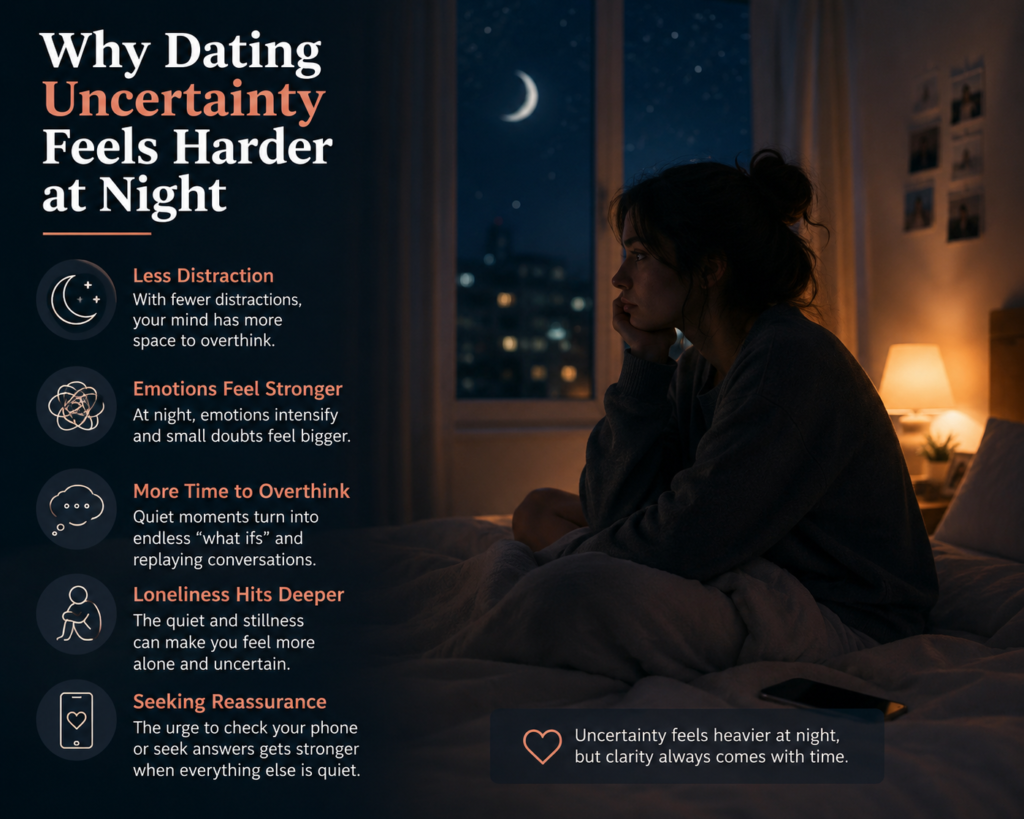
During the day, attention is naturally divided across work, errands, conversations, and other obligations, which limits how much mental space any single worry can occupy. At night, especially once other tasks are finished and the mind isn’t actively engaged elsewhere, that natural distraction disappears. Without competing demands for attention, unresolved emotional concerns — including dating uncertainty — have far more room to expand and dominate your thoughts.
This isn’t a sign that the situation is actually worse than it seemed during the day; it’s simply a reflection of how much less competition your thoughts have for your attention once the day’s distractions fall away.
Cognitive and Emotional Regulation Weakens With Fatigue
By nighttime, most people have used up a significant portion of their daily cognitive and emotional regulation capacity — a limited resource that gets depleted through the ordinary demands of a day. This is sometimes referred to as decision or willpower fatigue, and it applies to emotional regulation as much as it applies to decision-making. With less regulatory capacity available at night, the same level of uncertainty that could be managed calmly during the day can feel disproportionately overwhelming once your regulatory resources are more depleted.
This explains why perfectly reasonable thoughts during the day (“I’ll just wait and see”) can turn into spiraling, catastrophic thinking at night (“this is clearly never going to work”), even though the underlying facts haven’t changed at all.
Circadian Biology Plays a Real Role
There’s a biological component to this pattern as well. Cortisol, a hormone closely tied to stress response, naturally follows a daily rhythm, typically peaking in the morning and declining through the day — but the relationship between cortisol rhythm and evening anxiety is more complex, and several other biological shifts happen as night approaches that affect emotional processing. Melatonin release, associated with sleep onset, has also been linked in some research to changes in emotional processing and increased rumination in the period before sleep.
While the exact biological mechanisms are still an active area of research, the practical experience — that anxiety and rumination often intensify in the hours before sleep — is well documented and widely reported, independent of the precise underlying biology.
Nighttime Removes the Option of Immediate Resolution
A significant part of what makes nighttime uncertainty feel worse is that it’s genuinely harder to resolve anything at that hour. You can’t reasonably call a friend for a lengthy conversation at midnight the way you might during the day, texting someone late at night about an uncertain situation often feels inappropriate or anxiety-inducing in its own right, and there’s no ability to distract yourself with productive activity the way daytime naturally allows. This combination — heightened emotional intensity paired with reduced ability to actually do anything about it — creates a particularly uncomfortable kind of stuck feeling that’s specific to nighttime rumination.
The Absence of Real-Time Feedback Makes Space for Worst-Case Thinking
During the day, ongoing activity and interaction provide a constant stream of small, grounding feedback — a friend’s reaction, a work task completed, general engagement with the world that implicitly reassures you that things are, in general, okay. At night, that steady stream of feedback disappears, leaving more room for your mind to generate its own narrative, unchecked by any real-time information from the outside world. Without that grounding feedback, worst-case interpretations of an uncertain dating situation can feel more plausible than they would during a day full of more balanced, varied input.
Why This Matters for How You Interpret Nighttime Thoughts
Understanding this pattern has a genuinely useful practical implication: nighttime thoughts about dating uncertainty are less reliable than daytime thoughts about the same situation, simply due to reduced regulatory capacity, increased rumination-friendly conditions, and the absence of grounding real-world feedback. This doesn’t mean nighttime feelings aren’t real or worth acknowledging — it means the specific conclusions drawn during that state deserve some healthy skepticism, rather than being treated as more accurate simply because they feel more intense.
A useful practice is to notice when a spiral of worry is happening late at night and consciously remind yourself that the intensity of the feeling right now doesn’t necessarily reflect the actual severity of the situation — and that revisiting the same thoughts in daylight, with a rested mind and more available regulatory capacity, often produces a meaningfully different, more balanced perspective.
What Actually Helps
A few practical strategies can reduce the intensity of nighttime dating anxiety. Establishing a rule against checking texts, rereading old conversations, or engaging in extended analysis of a dating situation in the hour or two before bed can prevent the specific triggers that tend to kick off a spiral. Journaling briefly — writing down the worry rather than letting it loop mentally — can also help externalize the thought enough to reduce its grip, without requiring immediate resolution.
If a spiral does start, a useful technique is explicitly telling yourself that you’ll revisit the thought during the day, when you’ll have more capacity to think about it clearly, rather than trying to resolve the uncertainty at the exact moment it feels most overwhelming.
The Takeaway
Dating uncertainty genuinely does feel harder at night, and this isn’t a personal weakness or evidence that the situation is worse than it seems — it’s a well-documented pattern rooted in reduced daytime distraction, depleted emotional regulation capacity, biological shifts associated with the evening hours, and the absence of grounding real-time feedback that daytime activity naturally provides. Recognizing this pattern for what it is — a predictable feature of nighttime cognition, not an accurate escalation of the actual situation — can make those late-night spirals significantly easier to ride out until morning brings a more balanced perspective back into reach.
Leave a Reply