

Your cart is currently empty!
Why Someone Pulls Back After Showing Interest
Few dating experiences are as disorienting as watching someone who was clearly, enthusiastically interested suddenly become distant — slower replies, less initiation, a noticeable cooling that doesn’t come with an explanation. It’s a common enough pattern that it has an informal name in dating culture (“pulling back” or “hot and cold”), but the reasons behind it are more varied, and often less sinister, than the anxious mind tends to assume.
Understanding the range of genuine explanations can help you respond thoughtfully rather than spiraling into worst-case interpretations.
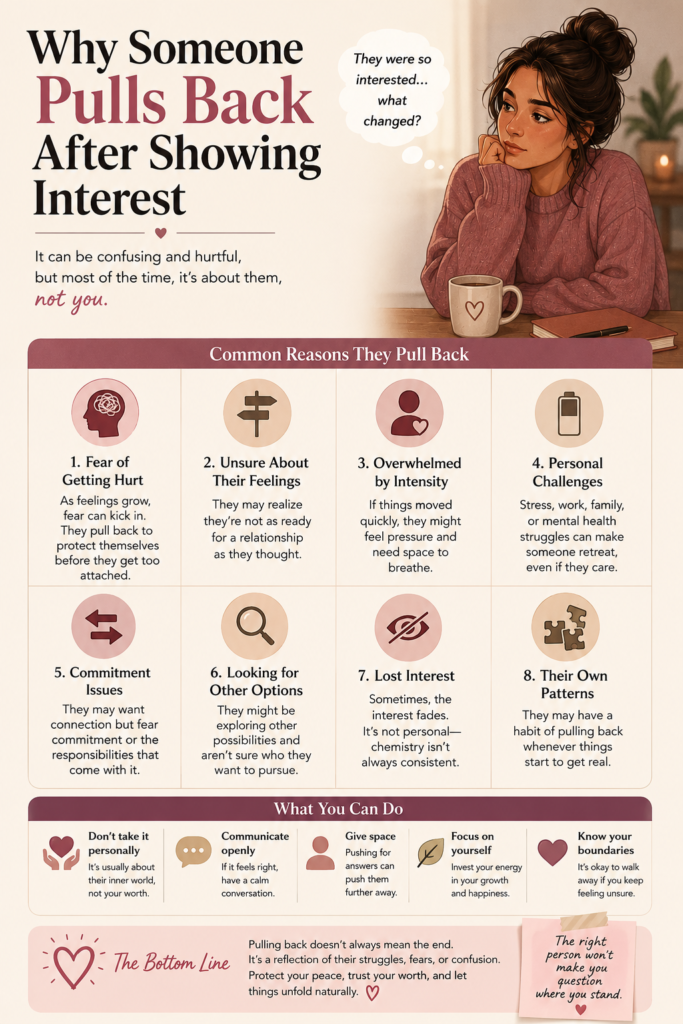
Fear of Vulnerability Is One of the Most Common Explanations
For many people, especially those with avoidant attachment tendencies, growing closeness can trigger an unconscious protective response, even when the connection is going well. As interest and emotional investment increase, so does the perceived risk of getting hurt — and for someone with a pattern of pulling away when things get too close, that increased risk can trigger withdrawal as a form of self-protection, even though nothing about the other person’s behavior actually caused it.
This kind of pulling back isn’t usually a deliberate, calculated decision — it’s often an automatic response to internal discomfort that the person themselves may not fully understand or be able to articulate in the moment.
Genuine Overwhelm, Not Necessarily Disinterest
Sometimes pulling back reflects simple overwhelm — by the pace of the relationship, by other life stressors competing for attention, or by uncertainty about their own feelings. Someone can be genuinely interested in you while also needing to slow down because the relationship (or life more broadly) feels like it’s moving faster than they’re able to process comfortably. This kind of pulling back is less about you specifically and more about their internal bandwidth at a given moment.
The distinguishing feature of this type of pulling back is that it tends to be temporary and often resolves once the person has had time to process, rather than escalating into complete disengagement.
Realizing the Connection Isn’t What They Initially Thought
Early interest is sometimes based on incomplete information or projection — enthusiasm generated by novelty, physical attraction, or an idealized early impression that hasn’t yet been tested by deeper knowledge of who you actually are. As more real information becomes available, some people realize their initial enthusiasm doesn’t hold up the way they expected, and they pull back as their genuine feelings adjust to a more accurate picture.
This explanation, while harder to hear, is honest and common. It doesn’t necessarily reflect anything wrong with you — it reflects the natural process of early attraction sometimes not surviving contact with fuller information, which is a normal (if disappointing) part of dating.
Testing Behavior or Self-Sabotage
For some people, particularly those with a history of getting hurt in past relationships, pulling back can function as an unconscious test — creating distance to see how you respond, or subconsciously trying to protect themselves from being the one who cares more. This pattern, sometimes described as self-sabotage, often stems from a belief (not always conscious) that good things don’t last, leading someone to withdraw preemptively rather than risk being disappointed later.
This explanation doesn’t excuse the behavior, but understanding it can help clarify that the pulling back may say more about the other person’s internal fears than about anything you did or didn’t do.
External Circumstances Unrelated to the Relationship
It’s easy to assume pulling back is always relationship-specific, but sometimes it reflects external stress entirely disconnected from you — work pressure, family issues, health concerns, or other life circumstances that reduce someone’s emotional bandwidth generally, not just toward you specifically. In these cases, the pulling back is real, but its cause has little to do with the quality or trajectory of the relationship itself.
This is worth considering, especially if the person had been consistently warm before the shift and hasn’t given any indication of dissatisfaction with the relationship specifically.
Genuine Loss of Interest
It would be inaccurate to suggest pulling back never reflects a straightforward loss of interest — sometimes it does, and pretending otherwise doesn’t serve anyone. Interest can fade for reasons that have nothing to do with fear or overwhelm — simply realizing, upon further interaction, that the compatibility isn’t as strong as initially hoped. This explanation, while sometimes the least comfortable to consider, is also often the simplest and most accurate one, particularly if the pulling back is sustained rather than temporary.
How to Tell These Explanations Apart
Distinguishing between these possibilities from the outside is genuinely difficult, since they can look similar in the early stages. A few things can help: temporary pulling back tied to overwhelm or external stress tends to come with some acknowledgment, even if brief (“sorry, things have been a lot lately”) — whereas pulling back tied to fear of vulnerability or fading interest more often happens silently, without explanation. Pulling back that resolves within a reasonable window (days to a couple weeks) is more consistent with temporary overwhelm; pulling back that persists or deepens over time is more consistent with fading interest or unresolved avoidance.
What to Do When Someone Pulls Back
Rather than immediately assuming the worst interpretation, it’s usually more productive to give a brief, reasonable amount of space, followed by a direct, low-pressure check-in: “I’ve noticed things feel a bit different lately — everything okay on your end?” This approach avoids both extremes — neither chasing anxiously nor silently disengaging without ever finding out what’s actually going on.
The response to this kind of question is often more informative than the pulling back itself. Genuine engagement, even if it comes with an honest explanation about needing space, is a different signal than continued vagueness or avoidance, which more often points toward fading interest or unresolved ambivalence.
What Not to Do
It’s worth naming the instinct to respond to someone pulling back by increasing your own pursuit — more frequent texting, more visible effort, more attempts to reignite the earlier enthusiasm. This response is understandable, but it rarely resolves the underlying issue, whatever it is, and can sometimes intensify a fear-of-vulnerability-driven withdrawal rather than easing it. A more measured response — giving reasonable space, checking in once directly, and then calibrating based on their actual response — tends to produce more accurate information and a healthier dynamic overall.
The Takeaway
Someone pulling back after showing real interest can stem from a range of genuine causes — fear of vulnerability, overwhelm, external stress, a more accurate reassessment of compatibility, or, sometimes, an honest loss of interest. The pattern itself doesn’t tell you which explanation applies; what matters is observing whether the pulling back is temporary and acknowledged, or sustained and unexplained, and responding with a direct, low-pressure check-in rather than either anxious pursuit or silent assumption.
Leave a Reply